

The first time Walt got stuck on the living room couch, he laughed it off. By the fourth time he was quiet about it, and quiet is worse. He was 71, seven years past his Parkinson's diagnosis, and the couch had gotten lower and softer without either of us noticing. What he needed was not a lift. What he needed was something to push against. That is the short answer to Vive Stand Assist versus the Carex UpEasy: the Vive gives you a handle, the UpEasy gives you a lift, and those are two different favors. Eight months on, the Vive is the one living on his end of the couch.
Here is how I would sort it if you were standing in my kitchen asking. A handle helps the person who can still stand but does not trust the chair to help him do it. A lifting cushion helps the person whose legs quit before the push even starts. Walt can still stand. He needed something honest to hold on to, and the rail gave him that. If his legs slide further, the arithmetic changes and I will be looking at a lifting cushion with a different attitude. Everything below is the detail behind that.
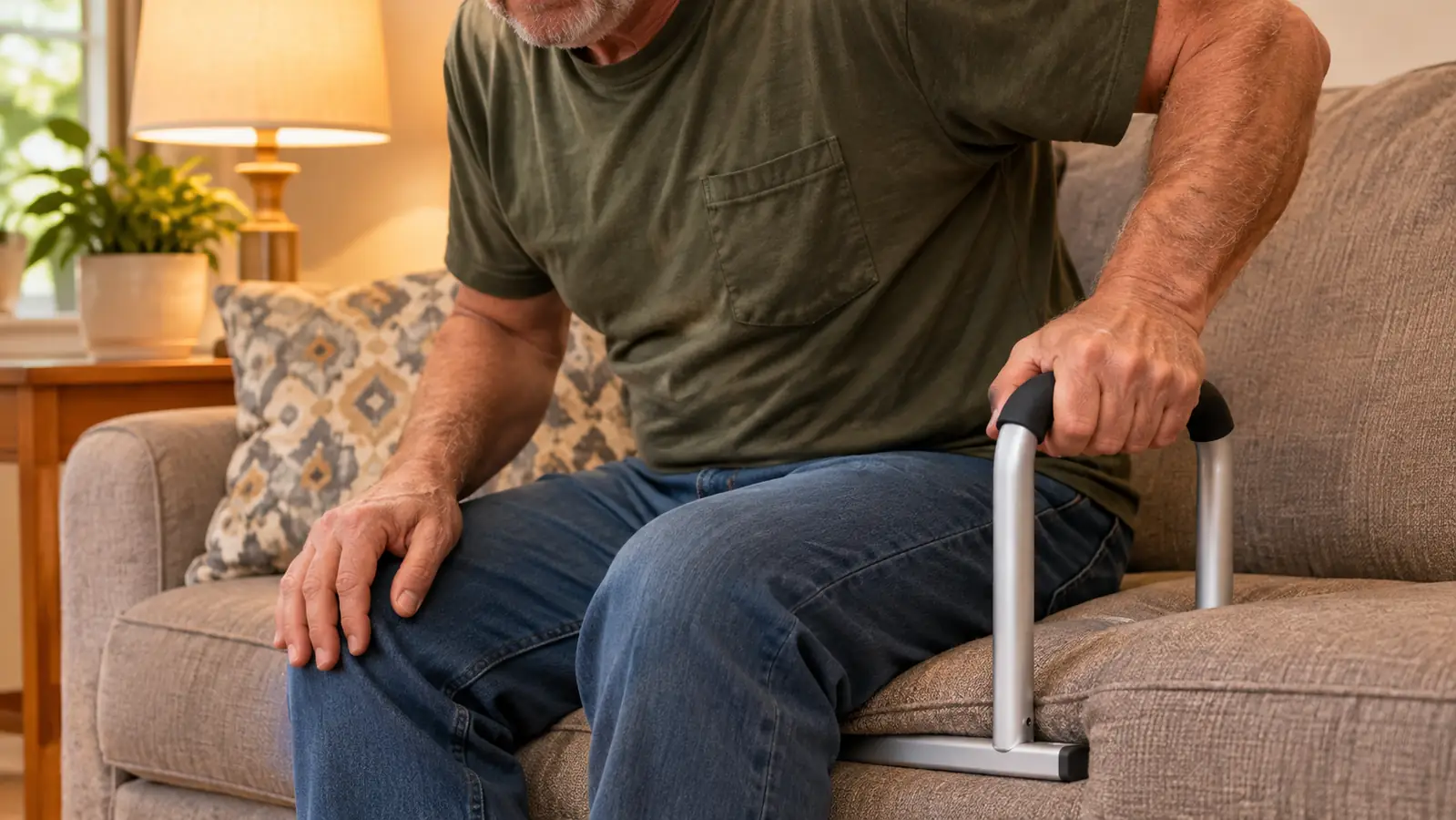
For anyone who has not seen either one in person: a lifting cushion looks like a thick seat pad. You set it on the chair, you sit on it, and as you lean forward it rises under you and takes part of the load off your legs. The Vive is not that. The Vive is a frame that slides under the cushion you already own, with a handle that comes up at the front edge of the seat. One is a seat that moves. The other is a handle that does not.
| Vive Stand Assist | Carex UpEasy | |
|---|---|---|
| What it is | An aluminum frame that slides under the cushion you already own, with a handle at the front edge | A thick lifting cushion that sits on the seat and rises under you |
| What it does for you | Gives you a fixed thing to grip and push against while your legs do the standing | Raises the seat so your legs have less distance to cover |
| Low, soft couch | Slides under the cushion and works with the give in the seat | A deep soft seat blunts the rise and makes it harder to sit down squarely on it |
| Tight dining chair | Needs a cushion to slide under or around, so a tight seat leaves nowhere to put it | Sits on top of the seat and needs no gap at all |
| Moving parts | None | A lifting mechanism that has to be working on the morning you need it |
| What it asks of the user | Arm and grip strength, plus the judgment to lean forward before pushing | The balance and timing to sit down onto it and lean at the right moment |
| Between uses | Nothing to recharge or inflate, but it walks forward on the cushion and someone has to push it back | Has to be sitting square on the seat to work as intended |
| Portability | 2.7 pounds, one hand, fits in the car | Cushion sized, so check the current listing for carry weight before you plan to travel with it |
| Weight rating | 300 pounds | Set by the maker and it varies by model, so check the listing |
| Cleaning | Wipe with a damp cloth | Follow the maker's care instructions for the cover |
Where Vive Stand Assist Wins
The Vive wins on the couch, and the couch is where the trouble actually lives. Ours is low and soft, and soft is the problem. Your hips sink, your knees end up level with your hips, and standing becomes a different job than it is from a dining chair. The frame slides under the cushion and the handle comes up at the front, so Walt can lean, plant his hand, and push himself upright the way he has done ten thousand times. Nothing has to rise first. When he is stuck, he wants to stand, not to operate something.
The second thing it wins on is having nothing that can fail. There is no charge to keep up, nothing to inflate, nothing to reset between one attempt and the next. It is an aluminum frame rated to 300 pounds, it weighs 2.7 pounds, and it wipes down with a damp cloth. The frame is about 19 inches across and it is adjustable, which mattered more than I expected. The first height I set had Walt reaching down and I could see his shoulder take the load wrong, so I raised it an inch and the whole motion changed. That was in the first week, and I have not touched the adjustment since.
I carry it to the dining room when the kids visit and back again afterward. The one maintenance item is real: it walks forward on the cushion over a few days and I push it back. If nobody in your house will check that, say so out loud before you buy.
Where Carex UpEasy Wins
The Carex UpEasy wins on the thing that matters most when this disease moves, which is that it lifts. A lifting cushion sits where your person sits and rises under him, so the distance between the seat and standing gets shorter instead of longer. No handle does that. If your husband cannot get his hips off the cushion even with something to pull on, a rail is the wrong purchase and I would tell you so to your face. There is a version of Walt two years from now that I would buy this for without hesitating.
It also wins on grip. Walt's right hand has a tremor that gets worse when he is tired, and on a bad evening a handle is a negotiation. A cushion that raises him lets his hands rest instead of clamp. And it wins on the chair with no give in it. The rail needs a cushion that lifts out or sits loose, and our dining chairs are upholstered tight with no gap to slide anything under. A firm, flat seat is exactly where a lifting cushion makes sense and a rail does not.
Our daughter's dining set is the same way, and the last time the family visited I watched Walt try to push himself up from one of those chairs with nothing but the table edge to hold, which is a bad plan and everyone at the table knew it. That is the room where I would want a cushion and not a handle.
The rail that ended the couch problem at our house
An aluminum frame that slides under the cushion he already sits on, a handle that does not move, and 300 pounds of support. It is what Walt pushes on every evening at seven o'clock.
Amazon Check Today's Price on Amazon →What Neither Device Does
Neither one of these gets Walt across a room. That is the rollator's job and it is a completely different job. Around the block, through the grocery store, down the long hallway past the bathroom, that is the four-wheeled walker with the seat on it. The rollator weighs about twenty pounds and I get it into the trunk of the Buick myself, which is a workout I have opinions about. All that is a different purchase for a different problem. The rail is for the ten seconds of standing up and the ten seconds of sitting back down. The cushion is the same. You buy one of these to fix a chair, not a hallway, and if you buy it expecting anything else you will be disappointed by Thursday.
Neither one prevents a fall. I am not going to sit here and tell you a handle makes my husband steady, because it does not. He still shuffles. He still freezes in the doorway to the hall with one foot up in the air, waiting for his body to catch up with his intentions. What the rail does is give him a controlled way to get from sitting to standing, and standing is when a lot of bad things happen in a house like ours.
And neither one is a substitute for the physical therapist. Walt did a round of PT when the freezing first got bad, and she is the one who suggested adaptive gear in the first place. She watched him stand up from a chair in an exam room and told us what she saw in about ten seconds. I cannot do that for your husband from my kitchen in Dayton, and a product page certainly cannot.

What It Is Like on a Slow Morning
On a slow morning the whole business takes longer and I have stopped hurrying it. Walt sits on the edge of the bed, uses the rail on his side of the mattress to get upright, and walks to the bathroom with one hand on the wall. By the time he reaches the living room he is ready to sit down again, which sounds ridiculous and is completely ordinary. Then he wants the television, the television means the couch, and the couch means the Vive.
One Tuesday in March it took us forty minutes to get from the bed to the living room, which is about thirty-five more than it used to. Nothing dramatic happened. He simply moved slowly that day, and I stood in the hallway with my hands in my pockets and let him. Hurrying him would have made it worse and both of us know it.
What I notice is that the rail gives his hand somewhere to aim. A tremor is not only shaking. It is a hand that arrives somewhere other than where he sent it. A handle that is always in the same place at the same height is easier to find than the arm of a couch with a loose cushion sliding around on it. He does not have to look as hard, and looking hard is its own kind of tiring.
Where a lifting cushion would change that morning is the fourth or fifth time he sits down, when his legs are done for the hour. That is the honest edge of the case and I would rather name it than pretend the rail covers everything. If your person is already there, skip the rail and go straight to the cushion. The rail is for the long middle stretch where standing is possible but the chair is not helping.
He did not need a lift. He needed something that does not move when he pushes on it.
Three Things I Would Check Before Buying Either
First, walk through the house and sit in every chair your person sits in. The Vive needs a cushion that lifts out or sits loose enough to work around, and it needs a seat that is not so deep that reaching the handle becomes its own project. A lifting cushion needs a firm, flat place to sit. If the honest answer is a soft recliner in the den, the rail is the fit. If the honest answer is the kitchen table, take the cushion seriously.
Second, watch him stand once and do not help. If the arms do the work and the legs follow, a handle is enough. If the legs stall and the arms cannot make up the difference, a handle is just something to hang from, and hanging from it will hurt your back too. That was the most useful thing our physical therapist told me, and she did not need a second look to say it.
Third, decide who resets it. Both of these devices need a person to put them back where they belong, and that person is usually the spouse. If the rail walks forward on the cushion, someone pushes it back. I check ours every few days, usually Sunday morning before church, and it takes about four seconds. But it is four seconds that belong to somebody, and if that somebody is already carrying the whole day, it is worth saying out loud before the box arrives.
And run either purchase past the neurologist or the physical therapist first, not because there is a wrong answer, but because they can watch your person stand and see which half is failing.
Who Should Buy Which
Buy the Vive Stand Assist if your person can still stand but the chair fights him. Low couches, soft recliners, a favorite armchair that has lost its springs, those are rail problems and not lifting problems. Buy the Carex UpEasy if the legs are the part that fails, if he cannot get his hips off the cushion even with a good grip, or if the only chair that matters in your house is firm and tight-seated. There is no rule that says a house cannot have both. Plenty do, and I would rather have the right tool in two rooms than the wrong one in the room where he spends his whole evening.
What I would say at the kitchen table is this. Neither of these is a treatment and neither one is going to slow anything down. They make one specific moment of the day easier and safer, and that is the entire claim. Walt still shuffles. He still freezes in that doorway. The rail did not change the disease by one degree. It changed the couch, and the couch was ruining his evenings.
Start with the chair that is causing the trouble
Eight months on, the rail is still under the same cushion at the same end of the same couch. Today's price and the current listing are on Amazon.
Amazon Check Today's Price on Amazon →