

The hardest part of Walt's day used to come at about nine fifteen at night. Not the walk to the mailbox. Not the shower. Not the doorway between the kitchen and the hall, where his feet sometimes forget what they were doing. It was getting off the couch. He would watch the credits roll, then lean forward, put both hands on his knees, and rock twice. Some nights that worked. Most nights it did not, and I would stand in front of him with my hands out and say "ready?" like we were about to move a piano. Walt is 71. He was diagnosed with Parkinson's seven years ago. Our couch is low and soft and completely unforgiving.
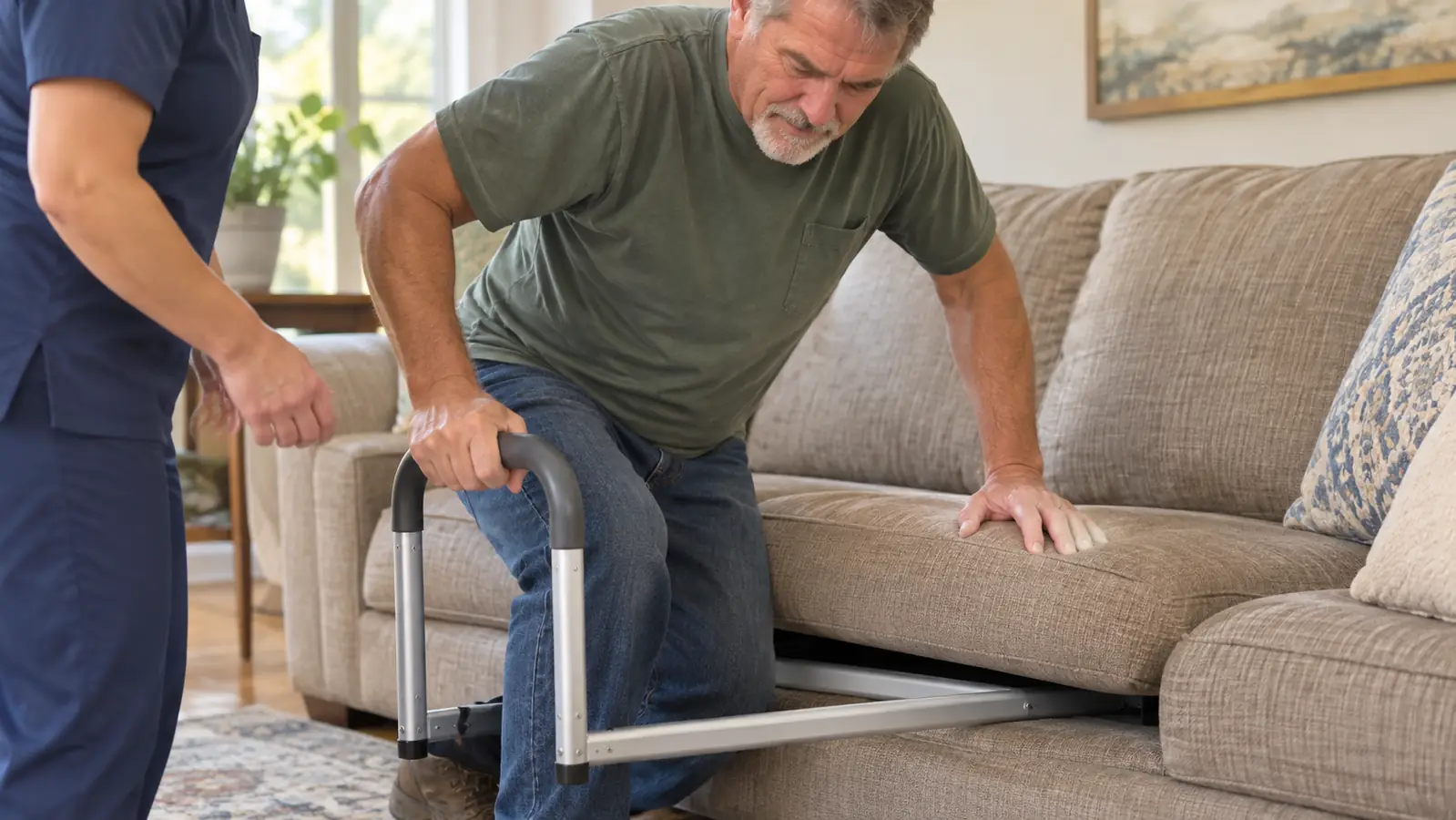
We bought the Vive Stand Assist about eight months ago. I want to be honest about what it did and did not do, because I read a pile of reviews before I ordered it and half of them sounded like they had been written by the box. It is an aluminum frame that slides under the seat cushion. It has a handle. Walt pushes on the handle and stands up. That is the whole idea.
Before the Vive, we worked through the usual list, and I am naming it because I think most caregivers walk the same path. I tried standing behind him and lifting under his arms. That worked for about three weeks and then my lower back filed a complaint. We tried a firm cushion to raise the seat height and he slid off it. We tried pulling on his hands, which is the one thing the physical therapist told us not to do, and she was right. None of it was foolish. None of it was enough.
What sold me was how little it asks of him. The frame goes under the cushion at his end of the couch and stays there. Vive rates it to support up to 300 pounds. The handle sits roughly where his hand already goes when he is trying to get up, so he did not have to learn a new habit at nine at night when he is tired and stiff. His right hand shakes more when he is tired. The handle does not care about the shake. It is just something solid to push against.
The first night he pushed, stood, and looked faintly annoyed that it had been that easy. He has used it every evening since. It weighs 2.7 pounds, light enough that he carries it to the dining table when the kids visit and sets it on the floor beside his chair. It wipes clean with a damp cloth, which matters more than I expected in a house where someone eats toast over the furniture.
It is not perfect. On our couch it shifts a little on the cushion if it does not get pushed back in place, so I check it every few days and shove it home. And I want to be plain about one thing: it does not lift him. Nobody should order it expecting a lift. It gives him a handle to push against so his own legs do the work, which is what his physical therapist wanted him doing anyway.
It does not lift him. It gives him a handle to push against and his own legs do the work. That turned out to be the difference between a good evening and a bad one.
The couch stopped being the hard part of the night
The Vive Stand Assist slides under a seat cushion and gives you, or the person you care for, a solid handle to push against. Aluminum frame rated to 300 pounds, 2.7 pounds to carry, wipes clean with a damp cloth.
Amazon Check Today's Price on Amazon →What I notice now is the quiet. For a year the end of the evening had a soundtrack: me asking if he was ready, him saying give me a minute, the two of us negotiating. Now he pushes up, stands, and shuffles down the hall to brush his teeth. I still watch him go. I just do not have to do anything about it.

It also changed how I sit. I used to perch on the edge of the chair across from him, waiting. Now I finish my tea.
If your house is like ours, the standing-up problem is not one problem. It is the couch, the dining chair, the bed, the shower, the car. We solved them one at a time and in roughly this order: the bed rail first, then the shower chair, then the rollator for outside, and the stand assist last, because the couch was the one I kept telling myself was fine. It was not fine. It was the piece of furniture he sits in for three hours every night.
The Vive is the smallest of those fixes and the one that gets used the most, which I did not expect when I ordered it.
What I'd Tell You If We Were Sitting at My Kitchen Table
Before you order one, walk over to the chair or couch that is giving you trouble and look at the cushion. The Vive fits around the base of a secure cushion or underneath a loose one, so it works on most upholstered furniture in a house like ours. If your cushion is attached and thick, or the seat is very deep, measure before you buy. If the person you are caring for cannot push down on a handle with at least one hand, this is not the right tool, and a conversation about a lift chair with the physical therapist is the honest next step.
The other thing I would say is the thing I say about all of it. Tell the neurologist and the physical therapist what you are buying and why. I am not a doctor and I am not going to pretend this is treatment. It is a handle. It is a good handle. It made the last hour of my husband's day something he does instead of something that happens to him, and eight months in, that is still the whole review.
Eight months later, it is still on his end of the couch
An aluminum frame that slips under the cushion, rated to support up to 300 pounds, light enough to move from the couch to the dining table. Backed by a lifetime guarantee from Vive.
Amazon Check Today's Price on Amazon →