

Our couch is low and soft and we bought it in 1998, back when getting off it was not a project. For a long time it was fine. Then Walt would finish his evening program, lean forward, push, and nothing would happen. He is 71, he was diagnosed with Parkinson's seven years ago, and the standing-up part has turned out to be harder than the walking part.
For about a year I was the crane. I stood in front of him, took both his hands, leaned back and hauled. My lower back sent me a letter about it. About eight months ago we put a Vive stand assist on his end of the couch, and the hauling mostly stopped. What follows are the ten reasons it earned its spot, in the order I would tell a friend at the kitchen table, including the parts that are not perfect.
The handle that ended the crane routine at our house
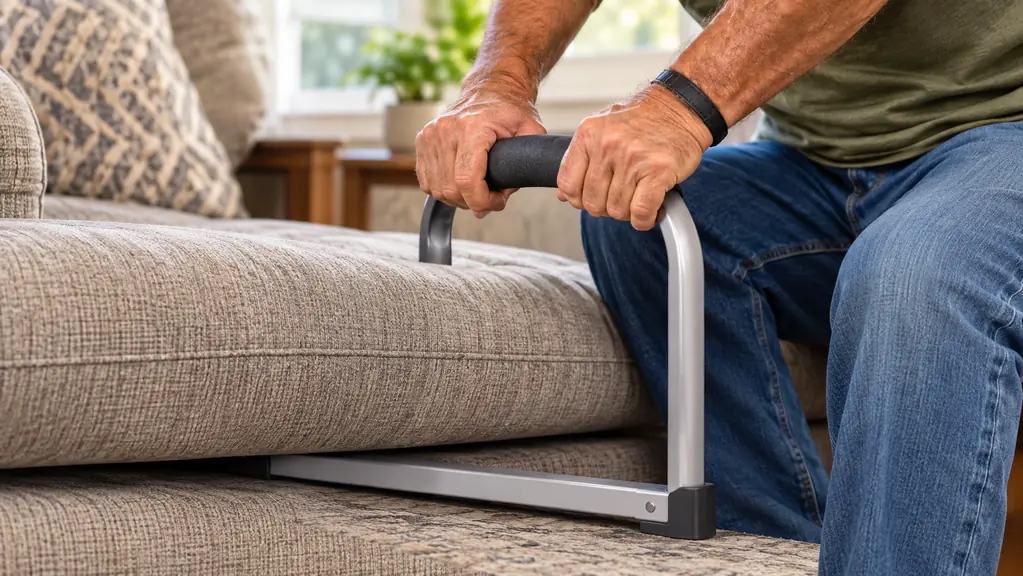
A slim aluminum frame that slides under the couch cushion and gives him something fixed to push on. Rated to support up to 300 pounds. Weighs 2.7 pounds, so you can move it with one hand.
Amazon Check Today's Price on Amazon →You stop being the crane
The first week we had it, I caught myself hovering. Old habit. Walt put both hands on the handle, leaned forward, pushed, and stood up while I stood there with nothing to do. Nobody was pulled. Nobody's shoulder got yanked out of its socket. If you have been the person hauling someone out of a chair, you know what a strange and good feeling that is. The rail does not lift him. He lifts himself, with his arms, on a fixed handle. That is the whole trick.
He gets up on his own schedule, not mine
Before, if I was in the kitchen and Walt wanted off the couch, he waited. Sometimes he waited twenty minutes and got stiff, which made the next part worse. Now he does not need to call for me. He pushes up, shuffles toward the bathroom or the kitchen, and I find out about it when I hear him. For a man who spent forty years as a machinist and does not like asking for things, that matters more than the physical help does. The Vive gave him back a small piece of running his own day.
It takes his weight instead of your back
The Vive frame is aluminum and rated to support up to 300 pounds. Walt is not a small man. My worry was whether a frame that slides under a cushion could really hold him while he pushed down on it. It does. It sits under the cushion against the couch's own base, so the load goes into the furniture and the frame rather than into a strap, a suction cup or my hands. That was the thing I needed to see before I trusted it.
The living room still looks like a living room
This was Walt's condition, not mine, and I understood it. He did not want the front room to look like a hospital room. The Vive stand assist fits snugly around the base of a secure cushion or sits beneath a loose one, so mostly what you see is the handle. Ours lives on his end of the couch permanently. Visitors do not ask about it. It is not a medical object parked in the middle of the floor for everyone to walk around.
It weighs less than a bag of groceries
2.7 pounds. I move it with one hand when I vacuum under it, and I am 66 with a temperamental back. Our rollator is around twenty pounds and lifting it into the trunk is a small workout every time. This is not that. If we visit our daughter and she has a soft chair in the den, I can put the stand assist in the car without planning for it. Portability sounds like a brochure word until you are the one carrying things.
It follows him from couch to recliner to kitchen chair
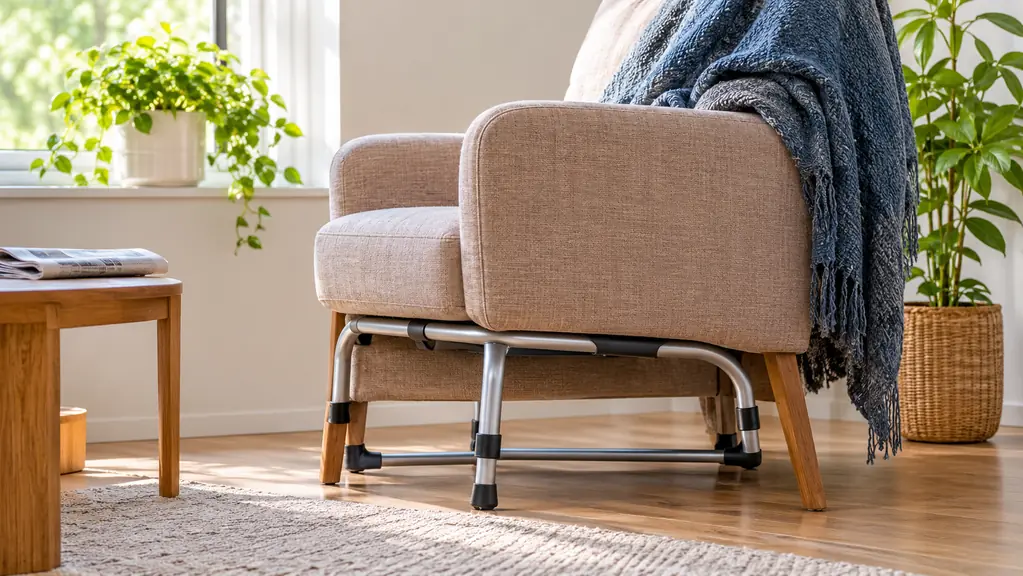
It is portable and adjustable, and the manufacturer says it works with any cushioned chair, sofa or recliner. The couch is where ours lives, but we have used it on the recliner in the back room, and on the kitchen chair on a cold morning when his knees were arguing with him. One rail, several chairs. That is a better use of a thing than a single-purpose gadget that only fits one seat and gets left behind when he moves rooms.
It fits the furniture you already own
The Vive frame is 22.25 inches wide and 12 inches high, and 19.25 inches front to back. That is couch-sized. We did not buy anything new to make it work and I did not have to measure the sofa before ordering. It slid into place on the first try. One honest note: if you have a chair with a very thick or a fixed cushion, look at those numbers before you order, because the frame needs to get under or around the cushion to be steady.
It is a push aid, not a lift, and that is the point
I want to be straight with you, because I read some reviews that were not. This does not raise him. It does not do the standing for him. What it does is give his arms a fixed, sturdy place to push while his legs catch up. On a bad day, when the tremor is worse and he is tired, he still needs a minute and he still needs me nearby. On a good day he is up in three seconds. Anything promising more than that is selling you something that does not exist.
Ten seconds to check, one damp cloth to clean
It shifts a little on the cushion if it is not pushed back in place, so I check it every few days. That takes ten seconds: push it back until it is seated. Wipe it with a damp cloth and you are done. No fabric covers, no pads, nothing to launder. I like gear that does not hand me a second job. Our shower chair has padded armrests and a back and needs more attention than this rail ever has.
The lifetime guarantee is worth more than you would think
Vive backs the stand assist with a lifetime guarantee. I have bought enough adaptive equipment over the last seven years to know that a company willing to stand behind a thing for its whole life is telling you something about how it was built. If a weld goes or the handle works loose two years from now, I make a call instead of hauling it to the curb. When you are the one who does all the ordering and returning in the house, that is not nothing.
For a man who spent forty years as a machinist and does not like asking for things, that matters more than the physical help does.
What I'd Skip
Here is what I would not spend on first. I would not start with a powered lift chair. They are large, they are heavy, they rearrange your whole living room, and if what your person needs is a push aid for one low couch, you have bought a great deal of furniture to solve a small problem. The Vive rail is the cheaper first move, and if it turns out not to be enough, you will know that quickly and honestly.
I would also not expect one piece of gear to fix every seat in the house. This rail lives on the couch, and it stays on the couch. The bed needed its own answer and the shower needed its own answer, which is how we ended up with a bed rail on Walt's side and a shower chair in the stall. Before you buy any of it, ask the neurologist or the physical therapist. Ours was the one who first pointed us at adaptive gear, and she was right about the order to buy things in. Nothing here treats Parkinson's. It just makes the ordinary parts of a day less of a wrestling match.
If the couch is the hard part of your evening, start here
A 2.7 pound aluminum frame from Vive, rated to support up to 300 pounds, that slides under a cushion and gives him a handle to push on. It does not lift him. It lets him lift himself.
Amazon Check Today's Price on Amazon →