

Our living room couch is low and soft, and for about a year it was the hardest piece of furniture in this house. Walt would watch the evening news, then sit there working up to standing while I pretended to read my book. He would rock forward once, twice, put a hand on the armrest, and push. Some nights it took three tries. Some nights I stood and offered my arm and he waved me off, which is its own conversation after forty-three years of marriage.
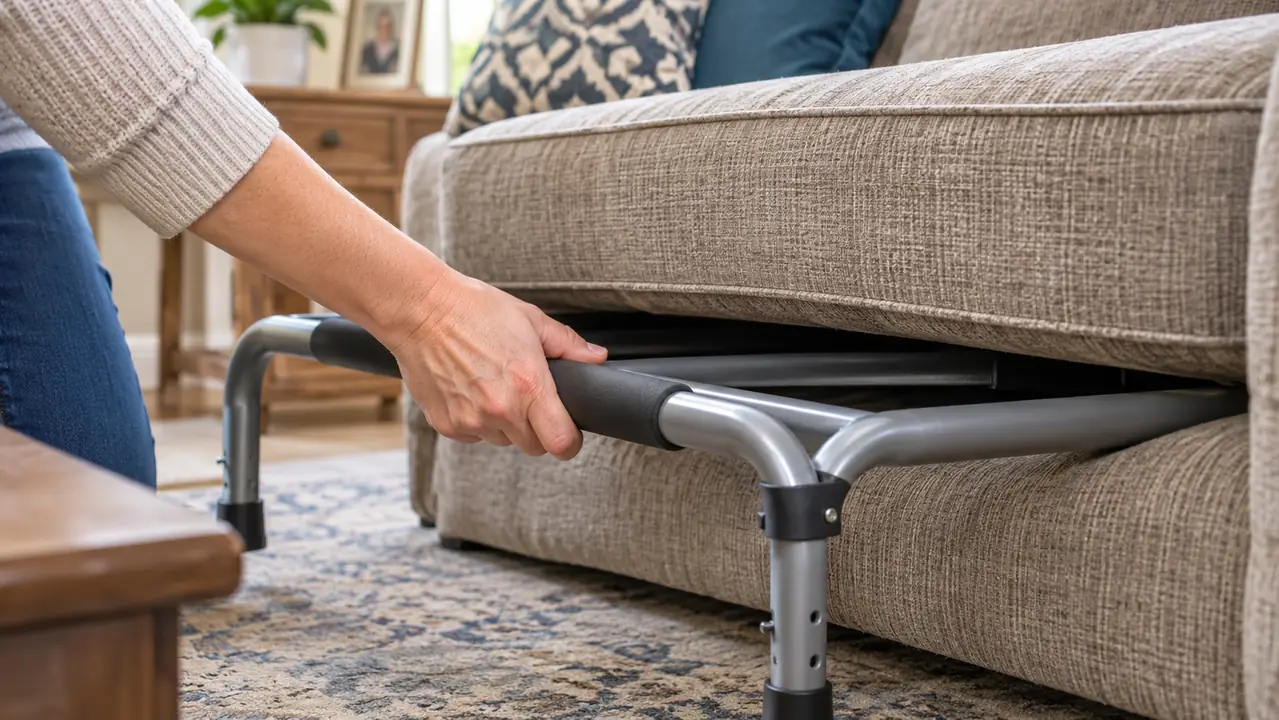
We bought the Vive Stand Assist about eight months ago. It is an aluminum frame that slides under the seat cushion on his end of the couch, with a rail he grips to push himself up. It does not lift him. It does not treat anything. What it does is give his hands and arms something solid to push against, so the standing stays his own work instead of mine. That distinction matters more to Walt than it does to me, and after eight months I have come to understand why.
Here is what daily use has actually looked like.
The Quick Verdict
It gave Walt a way to stand up off our low couch without my arm, and it has not needed a single repair in eight months. It creeps forward under the cushion and needs pushing back every few days, and it will not lift anyone who cannot push.
Amazon Check Today's Price →The rail that ended the evening standoff on our couch
Aluminum frame, 2.7 pounds, rated to support up to 300 pounds, slides under the seat cushion, with a lifetime guarantee from Vive. It gave Walt a way to stand on his own. Read the cushion fit notes below before you order.
Amazon Check Today's Price on Amazon →How I've Used It
The Vive stand assist has lived on Walt's end of the couch since the week we got it and has not moved rooms once. That tells you most of what you need to know. Gear that gets put away in a closet is gear that was the wrong shape for the problem. This one sits exactly where the problem was, which is why it gets used every single day and why I stopped thinking about it after the first month.
Setup took under a minute. I slid the frame under the seat cushion, pushed it back until it felt seated, and then sat down on it myself to see whether it would hold. It did. The frame is aluminum and weighs 2.7 pounds, so I can pull it out to vacuum under it and put it back with one hand. That matters when your own back is sixty-six years old and already does the lifting for two people.
The first week, I tried the cheap version of this first. I wedged a firm throw pillow behind his back to give him something to lean into, and for two evenings it seemed to work. By the third evening the pillow had slid sideways and he was pushing on air, which is worse than pushing on nothing, because it throws your weight forward with nothing to catch it. Before the pillow I had moved his end of the couch out from the wall so he could brace against the wall itself. He hated that. It made the front room feel like a waiting room, and he said so in about six words.
Morning and evening are the two runs. Couch after breakfast while he reads the paper, couch after the news before bed. Somewhere in the middle of the day it gets used again if he sits down to sort the mail. I check every few days that it is pushed all the way back under the cushion, because over a week of sitting and standing it creeps forward a little. That is the entire maintenance list. A damp cloth handles the rest.

What the Vive Stand Assist Actually Is
Strip away the packaging and it is a simple thing: an aluminum frame sized to slide under a cushioned seat, with a rail that sits at roughly hand height when you are seated. Vive lists the frame at 22.25 inches wide and 12 inches high, supporting up to 300 pounds. The listing says it fits around the base of a secure cushion or beneath a loose one, and that it works with a cushioned chair, sofa or recliner. In practice that description is accurate, and also incomplete, which I will get to.
The frame is adjustable and portable, which sounds like catalog filler until you have tried to move furniture with a bad back. It carries a lifetime guarantee from Vive. I have not had to test that guarantee, so I cannot tell you how the claim process goes. I can tell you the frame has not bent, wobbled, or loosened at any joint in eight months of twice-daily use by a man who leans his full weight on it.
What it is not is a lift chair. There is no motor, no rising cushion, no button to press. It is a rail and a frame, and everything that happens after you grip the rail is still your own legs doing the work. For some people that is the whole point. For others it is a dealbreaker, and I would rather say so now than have you find out the week it arrives.
The Cushion Fit Matters More Than Anything Else
Here is the one thing I would tell another caregiver before they order. The rail only helps if the frame stays put, and the frame only stays put if the cushion above it is heavy enough and seated well enough to hold it. Our couch cushion is fairly firm and fairly heavy, so the stand assist stays where I put it for days at a time. If your couch has a light, loose cushion you toss aside at night, expect to reposition the frame far more often than I do.
It also shifts a little on its own. Not dramatically, not enough that I have ever worried about it failing, but enough that after a few days it is no longer pushed all the way back. I check it roughly twice a week and shove it back in with my foot. That is ten seconds of my life. If you are the kind of person who will not remember to check, set a reminder on your phone for the first month until it becomes a habit.
One evening in February I skipped the check for close to a week. When Walt pushed up, the frame tipped forward with the cushion and the rail dropped an inch or so under his hand mid-push. He caught himself on the armrest. Nothing happened beyond a bad moment and a few sharp words aimed at me, but I have checked it every other day since. The lesson is not that the rail is unsafe. It is that a rail which has moved is a rail helping you less than you think, and you do not find that out until the night you lean on it.
On a deep, soft couch like ours, the rail sits a little lower relative to the seat than it would on a firm armchair, because you sink down into the cushion. Walt is tall enough that this works for him. A shorter person on the same couch might find they are reaching down rather than pushing up. Sit on your own couch, notice where your hand naturally falls when you push, and compare that to the 12 inch rail height before you decide.
What Eight Months of Evenings Look Like Now
The standing is faster. That is the plainest way to say it. Where Walt used to need two or three attempts to get off the couch, most nights now it is one push and he is up. Some nights it is still two, usually when he is tired or when his medication timing is off. But the long, grinding minute where he could not get started has mostly gone away, and that minute wore him down more than the standing itself ever did.
One night in early March I watched him do it without thinking about it, the way you or I get off a couch. He gripped the rail, leaned, pushed, and was halfway to the hallway before I registered that the whole thing had taken about two seconds. I did not say a word about it. If I had, he would have started thinking about the mechanics of standing, and thinking about it is half of what makes the freezing worse.
The other change is quieter, and I think it is the bigger one. He gets up on his own again. For a stretch there, every evening ended with me standing first and offering my arm, and him deciding whether to take it. Nobody enjoys being helped off a couch by their wife of forty-three years in their own living room. Now he grips the rail, pushes, and walks to the bedroom, and I stay in my chair with my book.
What has not changed: the tremor in his right hand, the shuffle in his step once he is upright, the freezing in the doorway between the living room and the hall. The stand assist does nothing about any of that and it was never going to. It solves one specific problem, standing up from a low seat, and it solves it well. I would rather have a tool that does one thing properly than something that claims to do everything.
What It Does Not Do
It does not help him out of bed. Different height, different leverage, different problem entirely. We use the bed rail on his side of the queen bed for that, and it has its own set of rules and its own learning curve. It does not help in the shower either, where getting up from the shower chair is a separate conversation. Anyone who tells you one piece of adaptive gear covers the whole house has not actually lived in one.
We tried it on a kitchen chair once, mostly out of curiosity, and it did not fit. The Vive frame is 22.25 inches wide and our kitchen chairs are narrower than that between the legs, so it sat on top of the seat instead of sliding under the cushion. Walt sat on it, said it was like sitting on a book, and we carried it back to the couch where it belongs. Worth knowing if your meals are the part of the day giving you trouble.
It does not replace his physical therapist. The PT is the one who suggested adaptive gear in the first place, and the PT is the one who told us to keep working on the strength side rather than leaning on the equipment. If you are thinking about this for someone in your house, that conversation comes first. Ask the neurologist or the PT what they want the person still doing for themselves, then buy gear that supports that, not gear that substitutes for it.
It also will not fix a recliner with a deep bucket seat, in my experience, because the geometry is wrong and the frame never sits level. And it will not help someone who cannot bear weight through their arms at all. If Walt could not push with his arms, this rail would be decoration, and we would be saving for a lift chair instead.
What I Liked
- Gave Walt a way to stand up off the couch without my arm, every evening
- Weighs 2.7 pounds, so I can pull it out to vacuum one-handed
- No motor, no buttons, nothing to charge or plug in
- Aluminum frame rated to 300 pounds has not bent or loosened in eight months
- Slides under the cushion, so the living room still looks like a living room
Where It Falls Short
- Creeps forward under the cushion over several days and needs pushing back
- How well it works depends heavily on how firm and heavy your cushion is
- Sits lower than ideal on a deep, soft couch for a shorter person
- Does nothing for the bed, the shower, or a recliner with a deep bucket seat
- Does not lift, so it is useless to someone who cannot push with their arms
The long, grinding minute where he could not get started is mostly gone, and that minute wore him down more than the standing itself ever did.
Who This Is For
This is for a household where someone can still stand but has lost the reliable push that gets them out of a soft seat. If the person you are caring for can bear weight through their arms, has decent balance once upright, and the main trouble is a low couch or a soft chair, this is the least complicated fix I have found. It is also for the caregiver who is tired of being the armrest, which is a real thing and not a small one.
It suits a living room that still needs to look like a living room. The frame disappears under the cushion, and nobody walking in sees a piece of equipment sitting in the middle of the floor. That mattered to Walt more than I expected. He did not want the front room to become a clinic, and eight months in, it has not.
Who Should Skip It
Skip it if the person cannot push with their arms, or if balance is poor enough that they would tip sideways once upright. A rail gives you something to push against. It does not keep you from falling and it will not catch you. If standing up has already become a two-person job, this is not the tool, and a lift chair or a proper assessment from an occupational therapist is the better next step.
Skip it too if your couch cushions are light and loose, unless you are willing to reseat the frame every single day. And skip it if the real problem in your house is the bed or the bathroom. We solved those with different gear at different times, and each one took its own round of guesswork. Buying the wrong tool for the wrong room is how the hall closet fills up with things nobody uses.
Eight months in, this is the piece of gear I would buy again first
If the trouble in your house is a low, soft couch and someone who can still push with their arms, start here. Check the current price on Amazon and read the cushion fit notes before it arrives. If the trouble is the bed or the shower, start there instead.
Amazon Check Today's Price on Amazon →