

Walt ate Thanksgiving dinner with a paper napkin tucked under his chin and would not look at his grandson across the table. He was not embarrassed about the napkin. He was embarrassed about the soup. Every time he lifted the spoon his right hand carried it a half inch sideways, and by the time it reached his mouth most of what had been in it was on the tablecloth or on him. He put the spoon down after four bites and said he was full.
That was fourteen months ago. The next week I bought the Vincere Silverware weighted set, four pieces and a roll-up bag, and I want to tell you the honest version of how that went, because the reviews I read back then were mostly written in the first three days. Here is what I know after a year and two months of washing these things three times a day.
The Quick Verdict
They do not calm the tremor. They make the food stay on the spoon more often, and that was enough to get Walt back to eating with the family. The first week he hated them.
Amazon Check Today's Price →Fourteen months in, the soup spoon is the one we would replace first
A four-piece stainless set with a roll-up travel bag. Dishwasher safe, which matters more than any of the brochure copy when you are washing them after every meal.
Amazon See the current price on Amazon →What Nobody Tells You Before You Buy Weighted Silverware
The reviews talk about weight like it is a feeling. It is not a feeling, it is a physics problem, and it helps to understand which problem you are solving before you spend anything.
A tremor is an involuntary movement, and it moves the whole arm. When your hand is holding something light, that involuntary movement pushes the object around easily, because there is nothing resisting it. A heavier piece of flatware resists the same push, so the wobble at the business end of the utensil gets smaller even though your hand is doing exactly the same thing it was doing before. I am not a doctor and I am not going to explain the physiology of Parkinson's to anybody. That is the mechanical idea, and Walt's neurologist nodded when I described it that way, which is as much confirmation as I need.
Before I spent anything on stainless steel I tried the cheap version of this idea, which was a pack of foam sleeves that slide over the handle of regular silverware. They cost about as much as a sandwich and they lasted eleven days in this house. The foam made the handle fatter, which did help Walt hold on, but it did nothing at all about weight, so the spoon still drifted and the soup still landed on the tablecloth. The sleeves also trapped water in the dishwasher and started to smell after a week, and I threw the whole pack out. If your problem is grip, sleeves are the cheap test and worth a try first. If your problem is the food falling off between the bowl and the mouth, sleeves will not touch it, and that gap is the one the Vincere set actually fills.
What this means in practice is that weight helps with the sideways drift of a loaded spoon. It does not help with the up and down of a hand that is shaking hard. It does not help with a hand that is slow to open. If the tremor is mild to moderate and the problem is food falling off between plate and mouth, you are the person this product is built for. If the tremor is severe, or if the problem is getting the hand to do what it is told at all, weighted silverware is going to be a disappointment and you will feel like you wasted the money. I would rather say that up front than have you find out the way I did with a different product two years ago.
The Week Walt Refused to Use Them
The set arrived on a Tuesday. I washed it and put the four pieces in the drawer with our regular silverware. That was a mistake, and I will get to why in a minute.
Walt picked up the fork at dinner and immediately put it back down. He said it felt like eating with a hammer. He said he was not a child. He ate that meal with his old fork and lost most of a baked potato onto his shirt, and then he went and sat in the living room and did not say anything for an hour.
I want to be honest about this part because the reviews skip it. Some of the resistance is not about the product at all. It is about what the product says out loud without anybody saying it. Walt has been losing small pieces of his independence one at a time for seven years, and a heavy fork was one more piece, and he was not ready for it on a Tuesday.
The Sunday after that was the low point, and I have thought about it a lot since. We had six people at the table and Walt ate with his old fork because the heavy one had embarrassed him on Tuesday. He got through about half a plate and then sat with both hands in his lap for the rest of the meal while everybody else talked around him. Our daughter asked him a question about the machine shop and he answered her in three words and then looked at the window. I cleared the plates and said nothing to anybody, and then I stood at the sink for a while with the water running and did not wash anything.
What worked was not a conversation. I put the regular silverware in a box in the pantry and left the Vincere Silverware in the drawer where the old stuff used to live. On Thursday he used the fork without commenting. By the next week he had opinions about which spoon he liked. That is the whole story. He needed it to not be a decision he had to make.
He said it felt like eating with a hammer. Two weeks later he was asking why the diner did not have spoons like his.
What the Four Pieces Actually Do at the Table
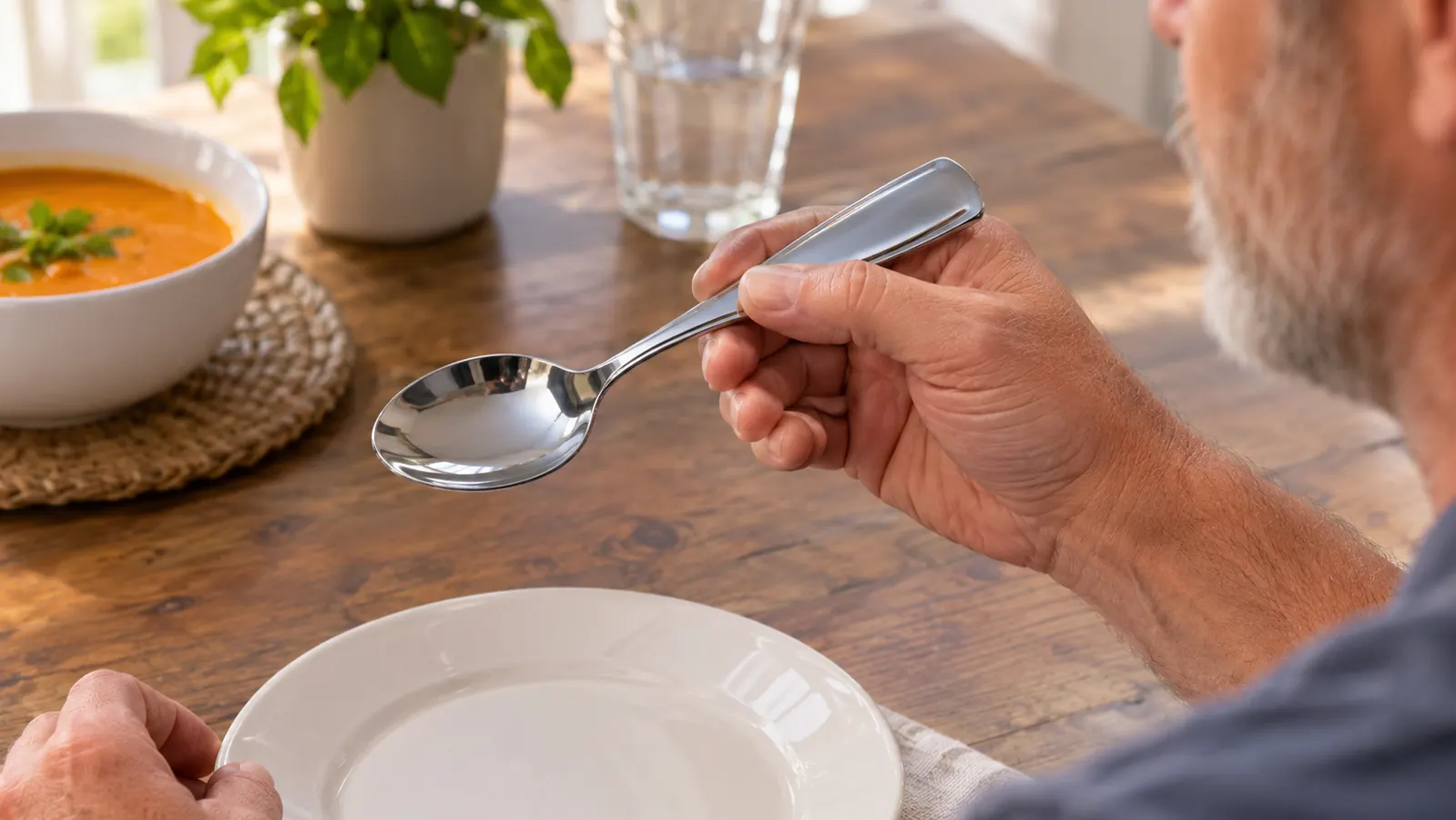
The set is a table knife, a fork, a tablespoon and a deep bowl soup spoon. Stainless steel, polished finish, a wide grip on the handle that is meant to be non-slip, and the whole set together weighs 1.8 pounds. The soup spoon gets the most use in this house by a wide margin, and if you are buying for one reason it should be soup, oatmeal, chili, ice cream, anything that has to travel on a rounded surface without sliding off.
The deep bowl is the part that surprised me. A regular spoon is shallow, so an unsteady hand tips the contents over the side before it ever gets close to a mouth. The bowl on this one holds more and holds it deeper, so a small tilt does not spill. Walt can get a full spoon from bowl to mouth about eight times out of ten now. Before, it was closer to three.
I put the whole set on the kitchen scale one afternoon because I wanted to know what 1.8 pounds actually means in the hand, and then I weighed one of our old forks next to it for comparison. The heavy fork is a fraction of that total, but pick the two of them up side by side and the difference is obvious before you lift either one. Our old forks feel like nothing to me now. I have caught myself eating lunch with the heavy spoon when Walt is not even at the table, which tells you the weight stops feeling strange faster than you would expect. It is the first two days that are the adjustment, not the first month.
The fork is the piece I am least impressed with, and I will say so. A heavy fork does better with a piece of chicken than a light one, but it does not solve the harder problem, which is getting the food onto the tines in the first place. If Walt is tired, the fork is still a fight and the spoon is still the reliable option. I have heard the same from two other caregiver wives in my position.
The knife is fine. Walt uses it for soft things. For anything that needs real pressure he uses a kitchen knife at the counter because the angle is easier when he can lean into it. I would not buy this set for the knife.
They go in the dishwasher, top rack or bottom, and they have been in there probably a thousand times. No rust, no dulling, no pitting. The polished finish on the handles has a few fine scratches from living in a drawer with other metal, which does not bother me or Walt.
The Travel Bag Is the Part I Use Most
The four pieces roll up into a fabric bag that goes in my purse. It sounds like a small feature. It has turned out to be the reason we still eat at the diner on Sundays.
Here is what happens without it. You sit down at a restaurant and the silverware is light and thin and Walt spends the meal fighting it, and by the end he is tired and quiet and wants to go home. With the bag, I hand him his own fork and spoon under the table and nobody at the next booth notices anything. He eats a full breakfast. We sit there for an hour like we have for forty-three years.
The bag also goes to our daughter's house at holidays. It has been through the washing machine once by accident and survived. It is not fancy. It is a roll-up pouch with slots, and it does exactly what it needs to.

Where These Lose, Honestly
The weight is the whole point and the weight is also the drawback. If Walt's hands are bad, lifting a heavy spoon is more work than lifting a light one, and there are evenings when he gets tired halfway through a meal and stops eating sooner than he would have otherwise. I have watched that happen. It is the tradeoff nobody puts in the product description.
The grip is wide, which is good for a weak hand and awkward for a hand that wants to hold a utensil the way it has held one for seventy years. Walt still holds the tablespoon like a shovel some nights. There is no groove or contour to guide you, it is just a thicker handle.
And the big one: this does not stop the tremor. Not a little, not partially, not at all. On a bad afternoon the soup still ends up on the tablecloth and the heavy spoon is just a heavier thing to be frustrated with. I want that in plain language because the listing photos suggest otherwise and that is not fair to anybody reading them at midnight after a hard dinner.
What I Liked
- The soup spoon keeps a full load from sliding off, which is the entire reason we bought the set
- Dishwasher safe after more than a year of daily washing with no rust, dulling or pitting
- The roll-up bag means Walt uses his own silverware at the diner on Sundays and nobody at the next booth notices
- Heavy enough to steady the sideways drift of a loaded spoon, light enough that a tired hand can still lift it
- The wide non-slip grip is noticeably easier for him to hold on a shaky morning
Where It Falls Short
- It does not stop the tremor, and the listing photos suggest it might
- A heavy spoon is more work to lift, so on bad evenings Walt tires sooner and eats less of his meal
- The fork is the weakest piece in the set. Getting food onto the tines is still a fight
- Walt hated them for the first week and said they felt like eating with a hammer
- The wide handle does not guide the hand, so he still grips it wrong some nights
How We Actually Use Them, Day to Day
The four pieces live in the drawer by the sink. They are not set apart as special equipment, which was a deliberate choice after the hammer comment. Walt reaches for them the same way he reaches for anything else. When our son visits he sometimes grabs one by accident and complains that our silverware is heavy, and Walt laughs at him, which is a small thing that means a lot in this house.
There is one habit that made more difference than any product I have bought. I set his place before he sits down, spoon where he reaches for it first, and I cut anything that needs cutting before the plate goes down. That sounds like a small courtesy and it is not. The less work there is between the plate and his mouth, the more of the meal he actually eats, and the heavy spoon is carrying the last few inches of that trip. Our table is about forty inches across and his chair is at the end nearest the kitchen, which means fewer steps for me when something needs fetching. Small arrangements like that do more than people realize.
At the diner on Sundays the bag comes out of my purse before the menus. At home, when Walt is having a bad hand day, I serve him something that works with a spoon without making a thing of it. Soup, stew, yogurt, oatmeal, mashed potatoes. That is not a compromise, it is just dinner.
We also stopped worrying about the tablecloth. There is a plastic mat under his place now and I wipe it down after every meal and it takes ten seconds. Between the heavy spoon and the mat, the laundry went from every day to twice a week. If you take one practical thing from this review, take the mat.
Who This Is For
This set is for the person whose hand drifts sideways when they lift a loaded spoon and who is still eating on their own. Mild to moderate tremor, food landing beside the plate instead of on it, a husband or wife or parent who has started eating less at meals because the meal has become a fight. That is the person who gets real use out of these four pieces.
It is also for the caregiver who is tired of doing laundry. That sounds small. It is not small. I was washing napkins and shirts every single day for months, and now I am not.
And it is for the household where the person with Parkinson's still wants to be at the table with everybody else. That is what this set bought us. Not dignity in the abstract, just a seat at Thanksgiving with a fork in his hand.
Who Should Skip It
If the tremor is severe, if the hand closes hard and involuntarily, or if the bigger problem is weakness rather than shake, these will make meals harder and you should look at a different kind of adaptive setup entirely. Have that conversation with the neurologist or the physical therapist before you buy anything. Ours was the one who suggested adaptive gear in the first place and I wish I had asked her sooner.
If the issue is grip and not weight, if the hand cannot hold a regular fork at all, a wide weighted handle is not going to fix that either. And if you are buying these for someone who has not agreed to use them yet, buy them anyway but expect the hammer comment, and give it two weeks before you decide it was a failure.
One more thing. If your household already has silverware you like, do what I did and put it out of sight for a while. Not forever. Just long enough that the heavy set stops being a verdict and starts being a fork.
The soup spoon is what got Walt back to the table
Four pieces, stainless steel, dishwasher safe, with a roll-up travel bag that lives in my purse. Fourteen months of daily use and they are still in the drawer.
Amazon Check today's price on Amazon →