

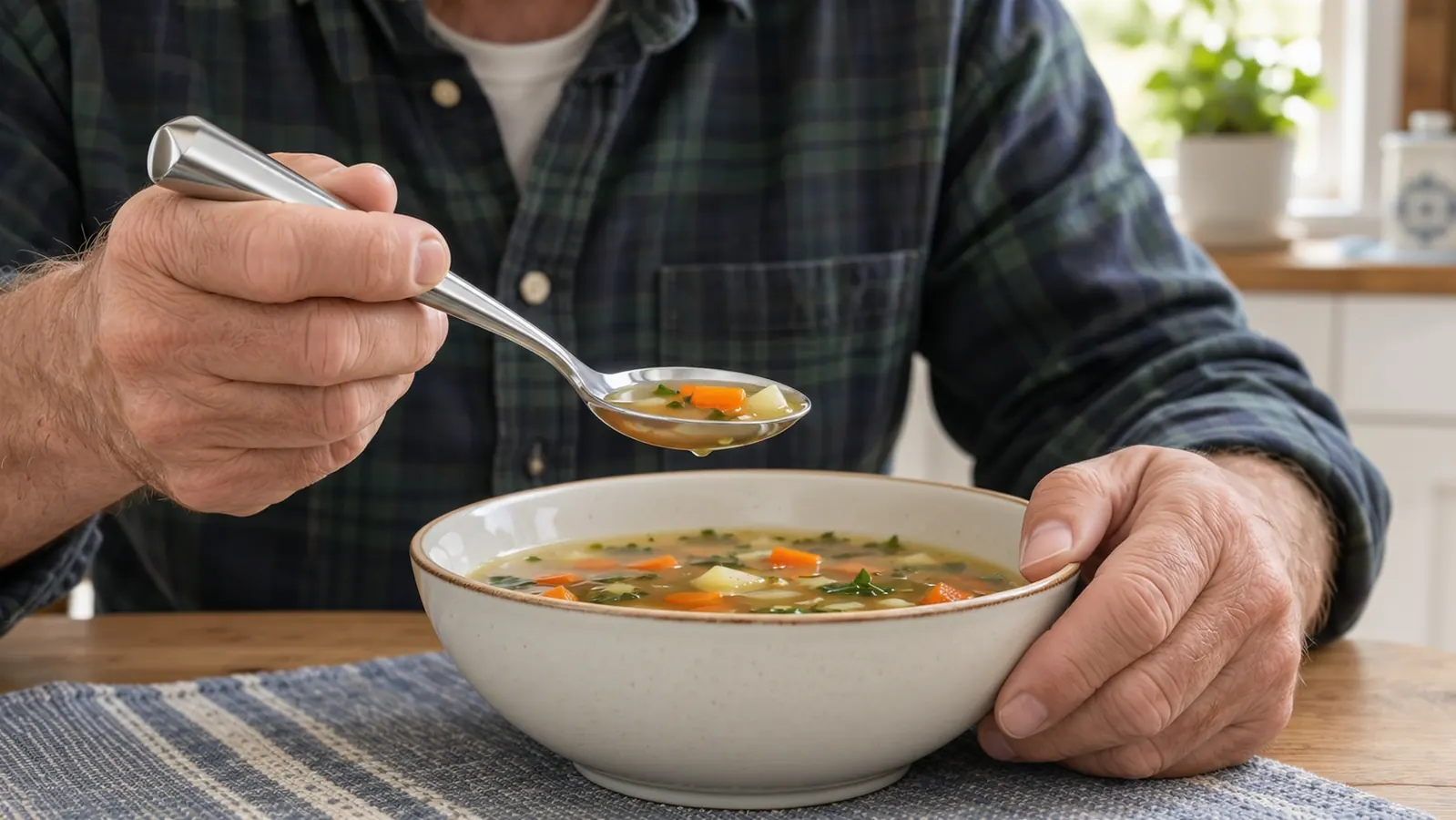
Every adaptive utensil listing promises a steadier hand and a cleaner shirt. Here is what actually happens at my kitchen table. My husband Walt was diagnosed with Parkinson's seven years ago. His right hand shakes, worse when he is tired, and about fourteen months ago he stopped finishing his soup, because by the last third of the bowl he was lifting a spoon that had already given up. That was the month we bought the Vincere Silverware weighted set. It did not stop the tremor. It made the food stay on the spoon more often, and around here that turned out to be the whole ballgame.
The other kind of set, the bendable handle adaptive flatware sold under names like Rumiq and Nourislif, does a different job. It is built for hands that cannot close, not hands that shake. Those are two different problems and the listings tend to blur them into one. So this is not really a brand fight. It is a comparison of two tools that get sold as if they were the same tool. I have used both kinds at my own table, and I have handled both at a support group meeting where four of us passed things around and compared notes. One of them lives in our silverware drawer. The other would have been the right purchase at a different stage of this disease, and I will tell you plainly which stage that is.
| Vincere Silverware weighted set | Bendable and strapped sets (Rumiq, Nourislif style) | |
|---|---|---|
| Weight in the hand | About 7 oz per piece, 1.8 lb for the four piece set. Heavy on purpose. | Light, with weight added in only a few of the models available. |
| Grip | Wide weighted nonslip grip and a large handle. No strap. | Contoured or padded grips, and many sets include a strap that holds the hand to the handle. |
| Handle shape | Fixed shape, the same four pieces for everyone. | Bendable or angled handles that you shape yourself. |
| What is in the box | Table knife, fork, tablespoon, deep bowl soup spoon, plus a roll up travel bag. | Usually fork, knife and spoon. Extras vary a lot from set to set. |
| Cleaning | Dishwasher safe stainless steel with a polished finish. | Varies. Plastic and padded parts are often hand wash only. |
| Eating away from home | Roll up bag included, and it fits in a purse. | A pouch or wrap comes with some sets and not others. |
| First week | Feels clumsy and heavy. Expect complaints. | Feels familiar in the hand almost immediately. |
| Best for | A moderate tremor in a person who still feeds themselves. | A very weak grip, or a hand that will not close around a handle. |
Where Vincere Silverware Wins
Seven ounces per piece does not sound like a feature until you have watched a spoonful of broth travel three inches, stop, and turn around. The set is built heavy on purpose, with a wide weighted grip and a large handle, and the weight is doing a small part of the work the hand cannot do that day. A heavy fork does not steady an arm. What it does is carry through a short distance, so the food reaches the mouth on a straighter line instead of wandering. Walt's tremor is moderate. On a good morning he barely needs the weight. By seven in the evening, after a long day of small movements, he notices it in a good way.
What we tried first, for the record, was the free version of this idea. I cut a length of foam pipe insulation from the garage, slit it down the side, and slid it over the handle of an ordinary teaspoon. It made the spoon fatter. It did not make it heavier, and a fatter spoon with no weight behind it did nothing at all about the line that spoon traveled across the table. Then I tried a single weighted spoon at a medical supply store in town. That one was better, but it was one spoon, the handle was plain steel, and Walt's palm slid on it once his hands got warm. The wide nonslip grip on the Vincere Silverware pieces is the part I did not know to ask for until I had it sitting in the drawer.
The second thing is that the Vincere Silverware pieces are real stainless steel utensils, not a padded handle bolted onto a stamped fork. They are dishwasher safe, and ours have gone through hundreds of cycles in fourteen months. The polished finish has a couple of faint scratches on the tablespoon. That is the entire damage report. I do not hand wash anything anymore, and for a caregiver that is not a small thing. The sink is where good intentions about adaptive gear go to die. If a thing has to be washed by hand and dried and put away separately, it stops being used somewhere around week three.
Third, the set comes with a roll up travel bag, and I did not expect to care about it. It lives in my purse. We eat at the diner on Sundays, and Walt used to spend the whole meal watching his own hand instead of talking to me. Now he unrolls his own fork and spoon and orders the soup. Four pieces, one bag, no ceremony. It rolls up small, sits beside my wallet, and I have never once had to dig for it. There is a version of this where the utensils stay home because packing them is a chore, and that version lasts about two weeks. Ours go in the bag, the bag goes in the purse, and the whole question is settled before we are out of the driveway.
Where the Bendable and Strapped Sets Win
Now the honest part. If the hand cannot close around a handle, none of that weight matters, because the utensil will not stay in the hand long enough to do anything. This is where the other family of sets earns its place. The Rumiq and Nourislif style sets are built around grip, with contoured shapes and often a strap or a moldable section that holds the fingers in place around the handle. A weighted fork assumes a hand that can hold. A strap assumes a hand that cannot, and works around it. For a person at a later stage of this disease, the strap is not a nice extra. It is the entire reason the tool works at all.
At the support group in January, the woman two chairs down from me passed her husband's strapped fork around so the rest of us could feel it. The strap was a soft band with a hook and loop closure that crossed the back of the hand and held the fingers against the handle. I put it on my own hand and I could not have dropped that fork if I had tried. That is precisely the right answer for a hand that opens without being asked to, and no amount of weight in the handle substitutes for it. Four of us sat there passing it back and forth, and every one of us said the same thing, which is that we wished we had known this distinction two years earlier.
The bendable handles matter too, and I did not appreciate this until I watched a woman at our support group use one. She could not rotate her wrist to scoop. With a straight handle, the spoon goes into the bowl at a bad angle and comes up empty, over and over, and everyone at the table pretends not to notice. She had bent her handle toward a right angle, and suddenly she was eating peas. That is a problem a heavy fork cannot solve no matter how much it weighs, and it is worth knowing before you spend money on the wrong kind of help.
The last concession is simple arithmetic. Seven ounces is not much to lift once. It is a fair amount to lift forty times in a meal. If Walt's arms were weaker than they are, if he were in the chair more than out of it, I would have bought the light set instead and I would not have felt bad about it. Weight helps a tremor. It does not help fatigue, and on a bad day it can add to it. The clearest example was a long day last spring: an early breakfast, an appointment across town, and supper at seven. He picked up the heavy spoon, got halfway through the bowl, and set it down. That was not the tremor. That was tired arms, and weighted gear is the wrong tool for tired arms.
Walt grumbled about the weight for about a week. Then he stopped leaving half his soup in the bowl, and he has not mentioned it since.
The Weight Is the Point: Check Today's Price on the Vincere Silverware Set
Four pieces at about 7 oz each, stainless steel, dishwasher safe, with the roll up travel bag that gets it out of the drawer and into the car. Rated 4.7 from 1,182 reviews.
Amazon Check Today's Price on Amazon →
How We Actually Use Ours
The deep bowl soup spoon gets the most use by a wide margin. It holds a real mouthful, and the bowl is deep enough that a small wobble does not sling anything over the rim. The fork is second. The tablespoon is what I reach for when I am serving him, which is not what it was sold for but is what happens in a real kitchen. The knife is the piece Walt uses least, mostly because I still cut his meat. That is a dignity thing we have not solved and I am not sure we will. I have never counted the lifts in a bowl of soup, but it is obviously fewer trips from bowl to mouth than our old spoon managed, and fewer trips means fewer chances to lose the load. A bowl that used to take the whole meal gets finished in about fifteen minutes now.
One thing nobody tells you: they feel wrong at first. Walt picked up the fork the first night, held it out at arm's length, and said it felt like something from a workshop. He was not wrong. They are heavy, the handle is wide, and the balance is different from the flatware he had used for fifty years. It took about a week of grumbling before his hand stopped arguing with it. If you buy a set like this and the first meal goes badly, give it seven more meals before you decide. By the third night he was using it without comment. By the second week I caught him holding the fork up to the window, turning it, looking at the weight in it the way he used to look at a part on the bench. He was a machinist for thirty-eight years. He understands a heavy tool. Once he decided it was a good tool, the argument was over and it has not come up again.
They go in the dishwasher with everything else, in the same basket, which matters more than the listing makes it sound. Adaptive gear that needs its own special handling is gear that quietly stops being offered. Ours just lives with the regular forks now, and nobody in this house thinks about it, and that is exactly what we wanted.
Who Should Buy Which
Buy the Vincere Silverware set if the tremor is the main problem and the grip is still there. If your person can close their hand around a fork but the food keeps sliding off before it arrives, weight is the lever you have not pulled yet. It also suits a household that wants one set to do everything: the table, the dishwasher, the Sunday diner, the trip to the kids' house at Thanksgiving. That is our situation, and fourteen months in I would buy it again without thinking about it.
Buy the bendable or strapped set instead if the hand is the problem rather than the shake. Signs to watch for: the utensil ends up on the floor more than once a week, the fingers will not wrap and stay wrapped, the wrist will not turn to scoop, or the arms tire before the meal is over. In that house, a heavy fork is a frustration and a strapped fork is a meal. There is no shame in either answer. It is a question of which stage you are in this month, and the stage can change.
One practical note on the trial itself. When Walt's physical therapist had him try three kinds, she put a bowl of macaroni in front of him rather than soup, because macaroni stays on a fork and lets you judge the grip without judging the splash. Then she had him do the whole thing again after he had been walking the hallway for ten minutes, because tired is the real test and a rested hand flatters every utensil ever made. If you get one chance to try these things before you buy, try them tired, and try them with food that is genuinely hard to eat. It will tell you more in five minutes than a shelf of listings will tell you in an afternoon.
Some households end up with both, and I think that is the most honest answer of all. Weighted pieces for the good mornings, a strapped or bendable piece for the evenings and for the foods that need scooping. What I would not do is guess. Walt's physical therapist was the one who first suggested adaptive gear, and she let him try three kinds on her table before we spent anything. Ask the neurologist or the PT to watch your person eat, and ask to try both kinds in the same appointment. And keep the expectations straight: this is equipment that makes a meal easier and safer. It does not treat Parkinson's, and no utensil on the market will.
Start With the Heavier Fork and See What Happens at Breakfast
If the tremor is the problem and the grip is still there, try this set first. Four pieces, about 7 oz each, dishwasher safe, travel bag included. Current price is on the listing.
Amazon Check Today's Price on Amazon →