
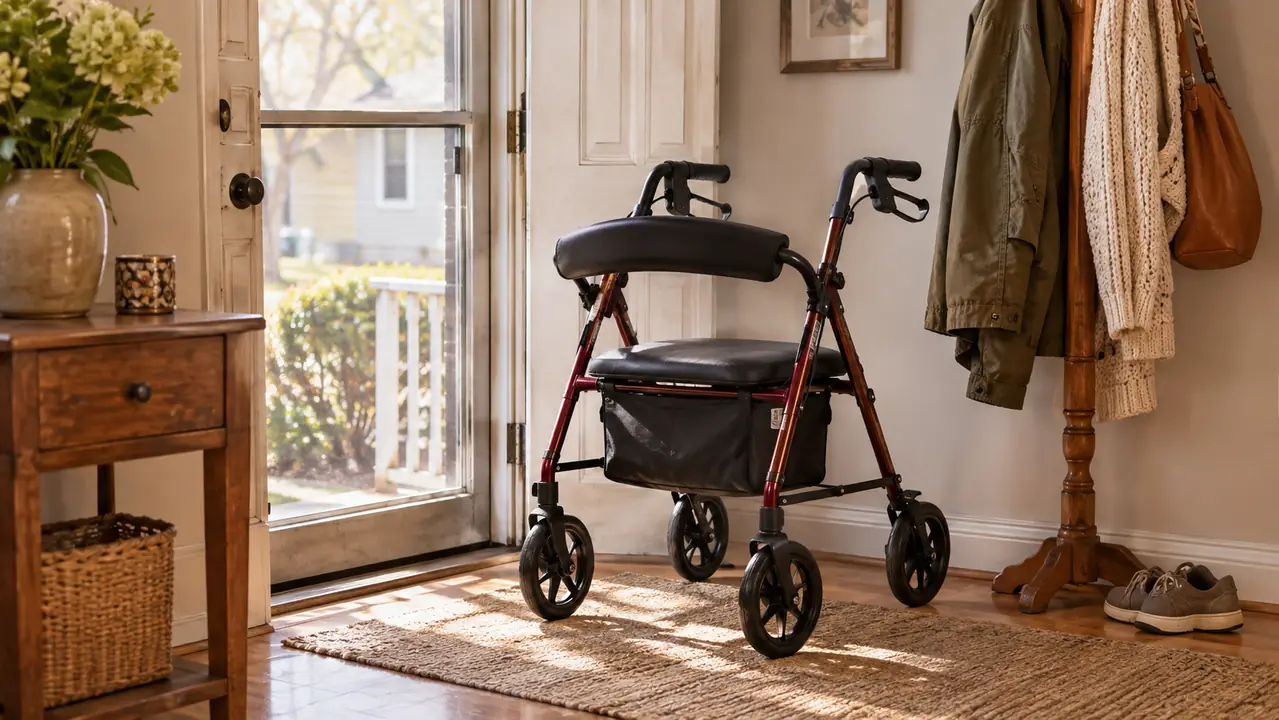
Walt caught his toe on a crack in the front walk two summers ago and went down on one knee. He did not break anything. He did stop leaving the house for eleven days afterward, and that scared me more than the fall did. That was the week our physical therapist asked what we had at home for walking support, and I gave her the honest answer: a cane he kept forgetting and a hallway wall he leaned on. She wrote a name on a sticky note. Drive Medical, four wheels, a seat, hand brakes. That rollator has been in this house for about two years now, and I have opinions.
This is not a story about a piece of equipment fixing anything. Walt has Parkinson's disease, diagnosed seven years ago, and no rollator on earth touches that. What the rollator does is narrower and more useful than fixing. It gives him something to hold that does not move when he leans on it, and it gives him somewhere to sit down before he has to admit he is tired. Those two things have changed how often he leaves the house.
The Quick Verdict
A plain, heavy, stubbornly reliable rollator. Two years of daily use and the frame, wheels and brakes have held up without complaint. Lifting it into a trunk is real work, and it will not fit a narrow bathroom door.
Amazon Check Today's Price →The gear that got my husband walking to the end of the block again
Four wheels, a padded seat, a fold up back support and hand brakes. Ours has gone out most days for about two years, indoors and on sidewalks, and the frame and brakes have not given us a moment of trouble.
Amazon Check Today's Price on Amazon →How I've Used It
The rollator lives folded by the front door. It goes out with us most mornings for a lap around the block, and it comes along to the grocery, the pharmacy and the diner on Sundays. Walt sits on the seat halfway around the block, almost every time, and he sits on it in the checkout line when the line is long. Inside the house it stays in the long hallway between the bedroom and the kitchen, which is where his steps get short and shuffly in the late afternoon.
I will get the complaint out of the way first, because it is the one that never goes away. The listing says 20 pounds and I believe the listing. I lift it into the Buick trunk myself, and after two years I have a system, but it is a genuine lift and my right shoulder knows about it. If I were loading it in and out of a car four or five times a day, I would be shopping for something lighter. Once a day, I can do it.
Out in public it earns its keep. Walt takes it into the grocery and steers with both hands on the grips, and people get out of the way in a way they never did when he carried a cane. That is not a small thing. A cane makes him look like a man who might fall. The rollator makes him look like a man who has thought about it. He also likes that he can park it and sit down while I load the bags.
The handles adjust between 31 and 37 inches, and we set them somewhere in the middle so Walt is not stooping. Getting that right took an afternoon and one argument. If the grips sit too low you will see the person hunched over the frame with their shoulders up around their ears, which defeats the whole idea, and if they sit too high the rollator feels unsteady to whoever is holding it. Set the height with the person standing between the grips, not sitting down on the seat.

What Actually Changed Around Here
The distance is the thing I notice most. Before the rollator, a walk meant the length of the front walk and back, and Walt would find a reason to turn around. Now we do the block. It takes twenty minutes instead of forty, and not because he got faster. It is because he is not spending the whole walk negotiating with his own balance. He holds the grips, the frame takes the wobble, and he can look up instead of down at his feet.
The freezing in doorways is the other thing, and here I have to be careful about what I claim. The rollator does not stop freezing. What it does is give him something solid under both hands while he waits it out. He plants it, leans, and the moment passes, and then he walks through. Before, he would grab at the door frame, and a door frame is not built to hold a grown man's weight at an angle. I have watched him pull a towel bar half out of a wall that way.
There is a social change too, and I did not expect it. Walt had stopped wanting the diner because getting from the car to the table was the hard part, and he felt watched doing it. Now he rolls in, parks it, leans it against the wall and sits down. Nobody looks twice. He has ordered the same thing every Sunday for a year and a half, and he has stopped apologizing for the rollator, which honestly is the bigger change.
Night is the other thing. Walt gets up once or twice, and the hallway is dark. The rollator does not go into the bedroom, there is no room past the dresser, but it waits outside the door and he has it from there to the kitchen. The bed rail handles the getting up and the rollator handles the walking. Between the two of them I sleep better than I did two years ago, which is a strange thing to say about equipment.
We do the block now. Twenty minutes instead of forty, and not because he got faster. Because he can look up instead of down at his feet.
The Brakes, the Seat, and the Trunk
The hand brakes are the part I care about most, because of the tremor. Walt's right hand shakes worse when he is tired, and a brake that has to be squeezed hard on a bad afternoon is a brake that does not get used. These are handles you close your whole hand around rather than a lever you press with one thumb, and he can work them with his left hand when the right one is having a day. Two years in, the cables have not stretched enough for me to notice and I have not had to adjust them.
The seat gets more use than I expected. It is a padded seat between the rear wheels with a back support that folds up and lifts off, and Walt uses it as a bench more than as a chair. Halfway around the block. In the checkout line. At the pharmacy waiting on a prescription. The back support is the piece that matters for him, because sitting down is easy and sitting down without tipping backward is not. We leave it on. It lifts off in a second if we ever needed to stow it, and we never have.
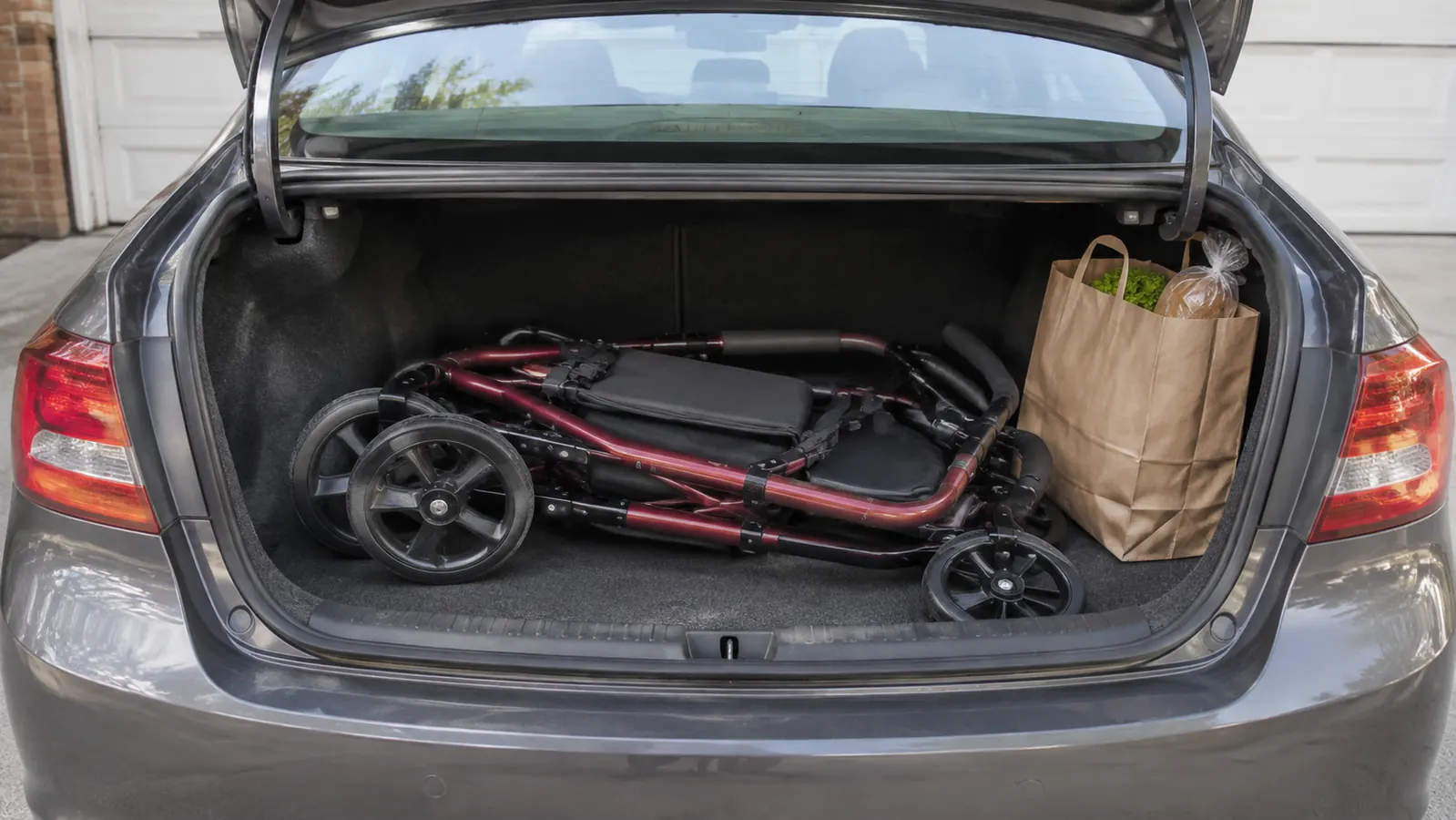
Folding it is one motion and it fits behind the passenger seat in the Buick with room to spare. That sounds like a small thing until you have owned a piece of equipment that does not fold. My mother had a walker in the nineties that had to be taken apart to go in a car, so it stayed home, and anything that stays home is not helping anybody.
What Two Years Has Worn and What It Hasn't
The Drive Medical frame is steel and it looks it. There are scuffs on the lower legs from the trunk and one small ding from the afternoon I misjudged a door frame, and if scuffs bother you, this will bother you. Nothing has bent. Nothing has loosened at a joint. The four 7.5 inch wheels roll the same as they did in month one, and they have gone over sidewalk cracks, gravel at the edge of the lot and the threshold strip between the kitchen and the hallway without complaint.
What I actually check is the brakes and the back support. Once a month I squeeze each brake handle and look at where the cable meets the housing, and once a month it looks the same. The back support lifts off and goes back on clean, which matters because it is the piece most likely to get knocked around in a trunk. The grips have not cracked or gone sticky. I wipe the whole thing down with a cloth when it gets dirty, and that is the entire maintenance routine.
The seat fabric has faded some over two years, which is what fabric does. It has not torn, and I have a theory about that. Walt is not a small man and he sits down hard, the way a man does when his knees have opinions. It has held him. The warranty is a limited lifetime one, and I have never had to use it, which is the best thing I can say about a warranty.
The Doorway Problem
Here is the tradeoff nobody mentions in the store. This rollator is too wide for our half bathroom, so it does not go in there. It stays in the hallway and Walt uses the wall and the sink in that room the way he always has. If your house is full of narrow doorways, measure them before you order anything with four wheels, because a rollator that cannot get into a room is a rollator that lives in a hallway. Measure the bathroom door, the bedroom door and the path past the kitchen table, and write the numbers down.
The other honest limitation is the lift. Twenty pounds does not sound like much until it is twenty pounds at an awkward angle over the lip of a trunk, and then it is a lot. I do it twice on a walk day, and I am sixty six with a shoulder that has opinions of its own. If I were doing it alone with no backup and no upper body strength to speak of, I would look hard at a lighter frame and give up the seat.
The learning curve was shorter than I expected and it did not happen in the house. The first week Walt used it in the hallway and hated it, because the hallway is narrow and he was steering it like a grocery cart. Out on the sidewalk, with room on both sides, he got the hang of pushing it a step ahead of himself instead of walking beside it. Three days. That was the whole thing.
What I Liked
- Frame, wheels and brakes have held up through about two years of daily use
- Hand brakes work with a whole hand squeeze, which matters with a tremor
- The padded seat and fold up back support turn it into a bench halfway around the block
- Folds in one motion and fits behind the seat in a sedan
- 300 pound weight capacity and a limited lifetime warranty
- Handles adjust between 31 and 37 inches to fit a taller user
Where It Falls Short
- 20 pounds is a real lift in and out of a car trunk
- Too wide for our half bathroom door
- The steel frame scuffs and shows every mark
- Nothing slows it on a slope except squeezing the brakes with both hands
Who This Is For
This is for the household where someone still walks, still wants to leave the house, and has started turning down invitations. That was us. Walt was not housebound, he was choosing to be housebound a little at a time, because the walk from the car to the table had turned into a negotiation. If that reads familiar, a four wheel rollator with a seat is worth the conversation with the physical therapist. Bring it up at the next visit rather than waiting for a fall to bring it up for you.
It is also for the caregiver doing the lifting, and I want to be honest that this purchase made my life harder in exactly one way, which is the trunk. It made everything else easier, including the part where I stop walking behind my husband with my hands out like a catcher's mitt. Drive Medical built a heavy thing that does not move when a person leans on it, and the heaviness is not a flaw. The heaviness is the point.
Who Should Skip It
If your hallways and doorways are narrow throughout and there is no way to clear a path, this will frustrate you daily. It is not a small frame and it does not turn on a dime. If your measurements come out close on the bathroom door, look at a narrower three wheel design and accept that you are giving up the seat, because a seat you cannot get into the room is not doing anything for you.
If nobody in the house can lift twenty pounds at an awkward angle, skip it or plan a ramp instead. The trunk lift is the part that wears a caregiver down, and I say that as a caregiver who does it. And if the person using it will not hold both grips, a rollator will not help. Walt took to it because the physical therapist handed it to him and told him why. Coming from me it would have been a suggestion. Coming from her it was an order.
Two years, one trunk lift a day, and I would buy it again
If the physical therapist has already suggested a rollator, this is the one that has held up in our house. Steel frame, four 7.5 inch wheels, a seat Walt actually uses, and brakes he can work with his left hand on a bad day.
Amazon Check Today's Price on Amazon →