

Walt hated Thanksgiving that year, and the turkey was not the reason. Our son and daughter had come in from out of state, the table was set with the good plates, and my husband of forty-three years sat down, picked up his spoon, and could not get the soup from the bowl to his mouth without half of it landing on the tablecloth. After the third time he set the spoon down and said he was not hungry. He was seventy-one, seven years past his diagnosis, a retired machinist who had spent a career doing precise work with those hands. That was the night I started looking.
About fourteen months ago we bought the Vincere Silverware weighted set: a table knife, a fork, a tablespoon, and a deep bowl soup spoon, plus a roll-up bag. It did not fix anything. The tremor in his right hand is still there, worse when he is tired, and no piece of flatware on our kitchen table is going to change that. What it did was make the food stay on the spoon more often, and that turned out to be enough to get him back to the table. Here is what I would tell another caregiver, in the order I would tell it.
The spoon that ended the towel-on-the-chest era at our house
Four pieces, weighted, dishwasher safe, with a roll-up bag that lives in my purse for Sunday at the diner. This is the set my husband uses at every meal.
Amazon Check Today's Price on Amazon →Half a bowl of soup stopped ending up on the tablecloth
The deep bowl soup spoon is the piece that earned its keep first. A deeper bowl holds more, and the weight seems to keep the spoon from turning over in his hand on the way up. It is not a neat trip from bowl to mouth. It is a trip that arrives. That spoon gets more use than the other three pieces combined in our house, and if you only ever buy one thing, this is the piece I would point at.
Amazon See the deep bowl soup spoon and the rest of the set →

The handles are wide enough for a hand that does not close all the way
Seven years of Parkinson's has made Walt's right hand slower and smaller in its movements, and a thin handle from our old drawer gave him nothing to hold onto. These handles are large, with a wide non-slip grip, so his fingers have something to wrap around even on a bad morning. If your person struggles to hold an ordinary fork, this is where the difference shows up first, and it shows up at the very first meal.
The weight takes about a week to stop complaining about
The Vincere Silverware set comes in at 1.8 pounds for the four pieces, and each one feels substantial the moment you pick it up. Walt grumbled for seven days. Too heavy. Too fancy. What was wrong with his own fork. Then he stopped mentioning it, and I noticed he was no longer switching hands halfway through a meal. Give it a full week before anybody votes on it. That is the honest advice, and I wish someone had given it to me on day one.
Dinner out stopped being something we avoided
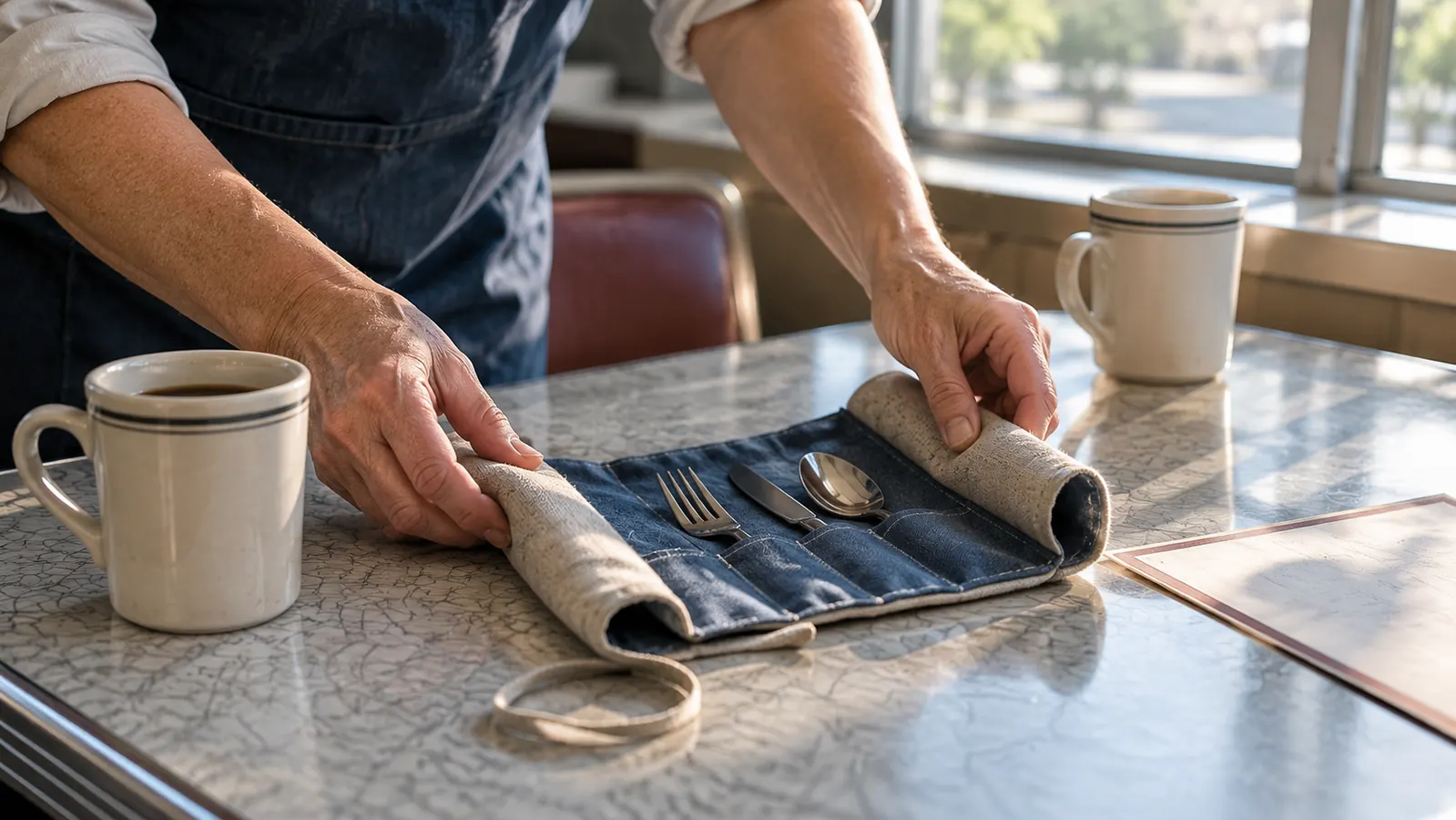
The roll-up travel bag lives in my purse. Sunday at the diner, we unroll it on the table and Walt eats with his own utensils instead of fighting whatever the restaurant provides. That sounds small. It is not small. There was a stretch where he would rather stay home than eat in front of strangers with a fork he could not manage. Now we go, and we sit in the same booth, and nobody looks twice at us.
They go in the dishwasher with the rest of the plates
I am sixty-six years old and I am not hand washing special flatware. The care instructions say dishwasher safe, and that is where the Vincere Silverware set goes every night, in the basket with everything else. Fourteen months in, mine still look like the day they arrived. No peeling, no spots where his thumb sits, no finish worn thin. For a caregiver, that is not a small feature. That is the difference between a set that gets used and a set that lives in a drawer.
Four pieces cover every meal we actually eat
Knife, fork, tablespoon, deep soup spoon. Not twelve pieces, not a drawer full of gadgets I have to learn. Breakfast is the fork and the tablespoon. Soup and cereal get the deep spoon. The knife does the cutting at dinner. Fourteen months of three meals a day and I have never once wished for a fifth piece. Simplicity is underrated when you are already running a household and a disease at the same time.
They do not look like medical equipment on the table
This mattered to Walt more than it mattered to me, and it mattered to me plenty. The set is polished stainless steel, so on the table it reads as good flatware rather than something from a hospital supply catalog. His brother came for a visit in the spring and never said a word about them. Walt noticed that. He brought it up after his brother left, and he was pleased about it, and I do not think I need to explain why that landed the way it did.
It gives him one thing at the table he is in charge of
I do not want to oversell this. The utensils do not treat Parkinson's. They do not stop a tremor, and they will not rescue a bad day. What they do is let him feed himself without help being offered every four minutes. There is a dignity in that I did not fully understand until it came back to us. He eats. I eat. We talk about the neighbors. That is the whole thing, and it is worth more than it sounds.
It settled the question of whether to keep buying gadgets
We have bought a few adaptive things over the years that ended up in the closet. The rollator earned its place by the door. The bed rail earned its place on his side of the mattress. This set sits in the same category: it does one specific job at one specific time of day, every day, and it does not need me standing over him to work. Before you buy anything adaptive, ask whether it gets used three times a day. If the answer is no, keep your money.
It gave me my dinner companion back
This is the reason I am writing a list at all. For about a year I fed my husband soup with a towel on his chest and told myself it was fine. It was not fine, not for him and not for me. Now he sits across from me, working through a bowl with a heavy spoon, complaining about the news. If you are at the towel-on-the-chest stage right now, I want you to know there is a stage after it. It took us a while to find.
What I'd Skip
If I were starting over, I would skip the search for one perfect gadget and skip anything that needs a whole new routine before it works. Talk to the neurologist or the physical therapist before you spend anything, the way we did after the PT first mentioned adaptive gear. We did not need an adaptive kitchen. We needed one set of heavy utensils that lives on the table, the rollator by the front door, and the rail on the bed. Everything else we bought sits in the closet, and I would rather you hear that from me than find it out the expensive way.
The soup spoon gets more use than the other three pieces combined. He finished a whole bowl the second week, and neither of us said a word about it.
One set, three meals a day, fourteen months and counting
The knife, fork, tablespoon and deep bowl soup spoon Walt uses at every meal, dishwasher safe, with a roll-up bag for Sundays at the diner. Ask the neurologist or the PT first, then take a look.
Amazon Check Today's Price on Amazon →