

Walt got stuck on our couch on a Tuesday night in February, and it took me a few seconds to understand what I was looking at. He was leaned forward with his hands on his knees, rocking, and nothing was happening. Our couch is low and soft and it swallows him. I stepped in behind him and helped the way I had a hundred times, and my lower back filed a complaint the next morning.
That was the week we bought the Vive stand assist. Eight months on, it sits at his end of the couch and the getting-up part of the evening has stopped being an event. I made a mess of the setup at first, so here is the sequence we settled on, in the order I wish I had done it.
The Rail That Ended the Two-Person Couch Exit
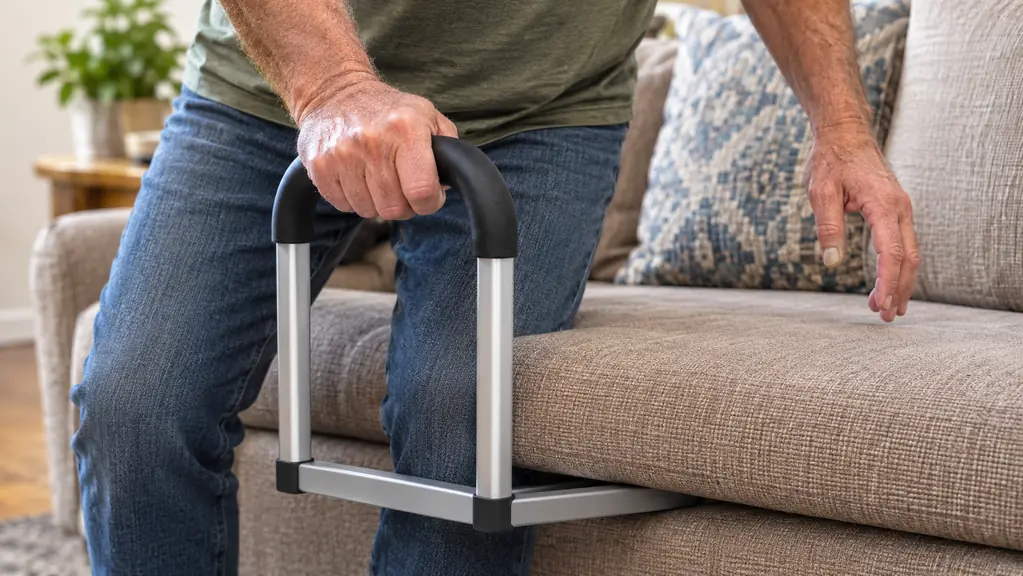
The Vive stand assist slides under the seat cushion and gives him something solid to push against at the right height. Aluminum frame, supports up to 300 pounds, 2.7 pounds total, wipes clean with a damp cloth.
Amazon Check Today's Price on Amazon →Why the Couch Is the Hardest Thing in the House to Stand Up From
A dining chair is honest. It is firm, it is high, and it does not move when you push on it. A couch is the opposite. The seat is low, the cushion gives, and the whole thing tilts you backward right when you need to go forward. For Walt, the shuffling steps and the freeze in the doorway are one problem, and a soft low seat is the other. Put the two together and you get a man who can walk to the kitchen but cannot get off the couch to start.
The stand assist does not lift anybody. It gives you something solid at the right height, close to your body, so the push goes down through the arm and into the frame instead of into a wobbling cushion. Walt still does the standing. That matters to him, and honestly it matters to me too.
Step 1: Measure the Couch, the Cushion, and the Floor Before You Buy
I bought ours without measuring anything, because I was in a hurry and annoyed. It worked out, but only because our couch happens to be an ordinary size. Measure three things first. The seat height from the floor to the top of the cushion. The width of the cushion where he sits. And the gap, if there is one, between the back of the cushion and the frame of the couch.
The Vive frame is 22.25 inches wide and 12 inches high, it weighs 2.7 pounds, and it fits snugly around the base of a secure cushion or underneath a loose one. That last part is the useful bit. It works with any cushioned chair, sofa or recliner, so you are not shopping for a new couch to go with it.
I finally measured ours on a Sunday afternoon with the tape from the kitchen drawer, months after the fact, out of curiosity more than anything. Sixteen inches from the floor to the top of the cushion, twenty-four inches across the seat where he sits. That sixteen is the number that matters. If your seat sits much lower than that, the rail sits lower with it, and the push gets harder instead of easier. I would want to know that before I ordered rather than after.
One thing I would check in the store if I had it to do over: how firm his cushion is. A cushion that slides around under him will slide the rail around too. Ours is medium firm and the rail stays where I put it, but I still push it back into place every few days.
Step 2: Slide It Under the Cushion and Sit On It Before You Trust It
The frame goes under the cushion with the upright part at the front edge of the seat, right about where his hand lands when he leans forward. Push it back until it stops. Then sit down on it yourself and lean your weight onto the rail. If it shifts, it is not back far enough.
I did that test with Walt standing next to me the first time, and then I had him do it with me standing next to him. Two rounds of that and we both stopped worrying. The whole thing took about ten minutes, including finding a spot in the garage for the box.
The one ongoing thing: the rail shifts a little on the cushion over a week of use. Not much, maybe half an inch, but half an inch is enough that I check it every few days and push it back. It takes four seconds. I do it when I straighten the pillows.
Step 3: Teach the Sequence, Not the Struggle
The physical therapist gave us a sequence and I will pass along the shape of it, with the usual note that your own PT may say it differently and their version wins. Feet flat and slightly back. Scoot to the front edge of the cushion. Nose over toes. Hands on the rail and push straight down. Then stand tall and take a breath before walking.
The part that helped Walt most was counting out loud. He rocks when he is unsure, and the rocking is what gets him stuck. Saying one, two, stand out loud gives him something to follow that is not his own balance. I say it with him. It feels a little silly in the living room and it works. The first week I got it wrong and counted too fast, the way you count when you are late for something, and he came up half straight and had to sit back down. Now I count at the speed he actually moves, which is slower than my instinct and faster than his hesitation.
The other thing we learned: pushing down on the rail is a different motion than pulling up on it. Pulling brings his shoulders forward and aims his face at the floor. Pushing down keeps his chest up. If your husband grabs the rail like a rope, that is the correction to make, gently, before he tries again.
We also stopped doing it on a schedule. Walt gets up when he gets up, and the rail is there either way. Waiting to be helped is its own kind of tired, and I did not understand how much of it I had been adding until we stopped.
The rail shifts about half an inch over a week of use. I push it back every few days, which takes four seconds, and that is the entire maintenance routine.
Step 4: Fix the Room Around the Couch
Gear alone does not solve a room. The coffee table was the first thing to go. It sat about fourteen inches in front of the couch, which meant Walt had to stand and then immediately turn, and turning is when he freezes. We moved it to the side wall and left a straight run from the couch to the hallway. The table has been a plant stand ever since and nobody has once complained about it.
The rug was next. Ours had a curled corner I had been meaning to deal with for two years. It is taped down now. The tape is the double-sided kind from the hardware store on the corner, and I ran it along all four edges rather than just the bad corner, because the other three were only pretending to lie flat. That took an afternoon and one short argument about whether we needed new carpet, which we did not. His lamp is on a side table he can reach without leaning, and his phone lives in his shirt pocket instead of on the cushion beside him, so he is not twisting around to find it after he is already up.
If your couch is very deep, a firm cushion or a folded blanket under the seat cushion raises the seat height a little and makes the whole thing easier. That is not a feature of the rail, that is just physics, and it costs nothing.
Step 5: Check the Rail, the Cushion, and the Floor Every Few Days
The stand assist wipes clean with a damp cloth, which is the whole care instruction and takes me about as long as it took to read. The weekly check is the part that matters. Push the frame back under the cushion. Look at the cushion itself for a tear or a soft spot where the rail sits. Look at the floor for anything that has slid under the front edge.
Every few months I tip the couch forward and look properly. I want to see the frame sitting flat against the couch and not cocked off to one side, and I want the cushion sitting level. Aluminum does not rust in a living room and 2.7 pounds does not sag, but a couch frame can, and if the couch has gone soft the rail will start to lean.
The Vive comes with a lifetime guarantee and I have not had to test it. If the frame ever bent or a weld ever let go, I would call them, because a bent rail is not something to keep using. That is one of the reasons I have stopped buying the cheap version of anything Walt puts his weight on.
What Else Helps
The stand assist solved the couch. It did not solve the bed, the shower, or the walk to the mailbox. Those were separate problems with separate answers in our house: a bed rail on Walt's side of the mattress for the mornings, a shower chair in the stall for the shaky days, and the rollator for anything outdoors. One piece of gear does one job, and the sooner I accepted that, the less money I wasted.
For a while I kept a list on the refrigerator of things that might help, and half of it was gear I had seen online at eleven at night with my reading glasses sliding down my nose. The half that actually worked was the boring half. Raise the seat. Clear the path. Put a light where he can reach it. Everything with a battery in it is still on the list.
The other thing that helped was the physical therapist, and I want to be plain about this. I am not a doctor and I am not giving medical advice. Walt sees his neurologist every few months and did a round of PT. The PT is the one who suggested adaptive gear in the first place, and the PT is the one who told us to stop helping Walt stand by pulling under his arm. I had been doing that for a year. It is a good way to hurt both people.
And a small one that surprised me: a lamp with a switch he can reach without stretching. Walt will not ask for help turning on a light. He will just sit in the dark and wait. One cheap lamp fixed a problem I did not know we had.

When the Couch Stops Being the Problem
If standing up gets harder in a way that is new, or if he starts needing two people instead of one, that is a call to the neurologist rather than a call to Amazon. The rail helps with a mechanical problem, which is a low soft seat and a tired man at nine at night. It does not help with a change in his condition and it is not supposed to.
What it does is narrow the problem. Walt stands up from the couch now without the rocking, most nights, and I stand nearby without my hand on him. Eight months ago that was not true. If your living room looks the way ours did, start with the measurement and the cushion, then teach the push, then fix the floor around it. The rail is one part of it. It is the part that made the rest possible.
One Rail, One End of the Couch, No More Two-Person Exit
The Vive stand assist is 2.7 pounds of aluminum that slides under the seat cushion and stays there. Supports up to 300 pounds. Wipes clean with a damp cloth. Measure your cushion height first, then check the current price.
Amazon Check Today's Price on Amazon →