

The first time I noticed it wasn't the tremor. It was the soup. Walt had been diagnosed with Parkinson's about a year before, and his right hand had that rolling motion that gets worse when he is tired. Breakfast was still fine. Then one Sunday he lifted a spoon and by the time it reached his mouth most of the broth was on the placemat. He set the spoon down and said he wasn't that hungry, which is Walt for I would rather not do this in front of you. I have thought about that afternoon more than I should. What changed our table was not a lecture and it was not a bib. It was a heavy four piece set from Vincere Silverware, a knife, a fork, a tablespoon and a deep soup spoon, plus about two weeks of me paying attention to how we set the table.
If you are where we were, you have probably already tried the free fixes. I cut his food smaller. I made soup in a mug instead of a bowl. I put a paper towel under the bowl and pretended not to watch him. None of that is wrong, exactly, but none of it touches the real problem, which is that a light spoon in a shaking hand is a fight the hand is going to lose. A heavier utensil does not stop the tremor and I want to be plain about that. Walt still shakes. What the weight does is make the food stay on the spoon more often, so a meal takes less out of him. That is the whole claim. It is a smaller claim than the ads make, and it is the one that held up in our kitchen for fourteen months.
The spoon that stopped ending up on the placemat
Vincere Silverware makes a four piece weighted set, a table knife, fork, tablespoon and a deep bowl soup spoon, with a wide non-slip grip and a roll-up travel bag. Dishwasher safe.
Amazon Check Today's Price on Amazon →Five Steps That Made Our Table Work Again
Buying the set was the easy part. What actually helped was a routine around it, and it took me a couple of weeks and one ruined Sunday dinner to get that right. Here is the order I would do it in if I were starting over. None of this is medical advice. Anything that touches Walt's Parkinson's gets run past his neurologist, and the adaptive gear idea originally came from his physical therapist.
Step 1: Choose the Utensil Before He Sits Down
I used to put the whole set on the table and let Walt sort it out, which was unfair to him. Now I match the tool to the food. Soup, stew, oatmeal, mashed potatoes and ice cream all get the deep soup spoon. It holds more, and the bowl shape keeps things from sliding off the side. Anything he has to spear gets the fork, and I cut the food small enough that he is not sawing at it with the knife, because sawing is the motion that sets his hand off. The knife comes out for soft things only.
The tablespoon is the one I did not expect to use. It turns out it is the right tool for a bowl of cereal, and for the last few bites when the bowl is nearly empty and the soup spoon cannot reach without tipping. Walt reaches for the tablespoon himself now. That sounds like a small thing. It is not. Him choosing his own utensil is him deciding the meal is worth the effort.
I keep a short list taped inside a cabinet door with masking tape. Soup spoon for anything wet, fork for anything he spears, tablespoon for cereal and the bottom of the bowl, knife only for soft food. Walt laughed at the list when I put it up in March. He reads it anyway, and so do I on the mornings when my own brain is still asleep. It sounds fussy. It saves me from standing at the drawer at six in the morning trying to remember which spoon we settled on.

Step 2: Set the Table So the Bowl Does Some of the Work
A weighted spoon helps. A bowl that slides across the table undoes that help in about four seconds. Our bowls are heavy stoneware with a lip, and I put them on a plain rubber mat instead of a cloth placemat, because cloth slides and rubber does not. If you do not have a mat, a square of shelf liner from the kitchen drawer works just as well and costs nothing.
I also stopped filling things to the brim. Two thirds of a bowl of soup that gets eaten beats a full bowl that gets abandoned. If Walt is still hungry there is more in the pot and he knows it. Same with a plate. Less food, more room to chase it around, and a second helping available. It looks like a step backward. It is not.
One more thing about the table itself. Walt sits at the end now instead of the middle, where he has room on his right side and nothing to knock into. His elbow can rest on the table edge, and that gives his forearm something to brace against, which steadies the whole arm without him thinking about it. That change cost me moving one chair.
The chair matters as much as the mat. Ours is a plain wooden one with arms, and the arms are the point, because he can push down on them to settle himself before he starts. The padded roller chair we tried first was too soft and he sank into it, which put his plate lower than his elbows and made him reach down for every bite. We gave that chair to our daughter and nobody has missed it.
Step 3: Fix the Grip, Not the Tremor
The Vincere Silverware handles are wide and textured, and they are meant to be held with the whole hand rather than pinched between two fingers. For the first week Walt held them like he was afraid of them, tight and high up near the neck, and he grumbled that they felt like tools. I let him grumble. Around day eight he relaxed his grip and moved his hand down, and the difference was obvious. Less white knuckle. Less fatigue by the end of the meal.
Do not tell your husband to grip harder. I made that mistake once and got a look I had earned. Squeezing makes a tremor worse, not better, and it tires out the forearm before dessert. The weight is supposed to do the steadying so the hand can stay loose. If the handle feels slippery, wipe it with a damp cloth before the meal. That helps more than a tighter fist.
There was one bad Tuesday in February when none of it worked. Walt had a cold, he had been up three times the night before, and by lunch his whole right side was tired. I made him a sandwich cut in quarters and let him eat it with his fingers at the counter, standing up, with his coffee beside him. Not every meal has to be a meal at the table. Knowing when to stop pushing is part of the routine too, and it took me longer to learn than the grip did.
The tremor did not go away. What went away was the puddle under the spoon, and that was enough to get Walt back to the table with the rest of us.
Step 4: Eat When He Is Fresh, Not When He Is Tired
Walt's hand is worst at the end of the day. By six in the evening it is a different hand than the one he has at nine in the morning. So we moved the big meal to midday wherever we can, and supper is lighter, soup or a sandwich or eggs. He eats better, he is less embarrassed, and I stopped spending an hour on a dinner he would only pick at.
We worked that out from a log I kept for two weeks in January, just a pencil mark on the calendar for good meals and hard ones. Nine in the morning was almost always fine. Six in the evening was almost never. Two weeks of pencil marks told me more than a year of guessing had, and I wish I had done it sooner instead of deciding his day for him by feel.
The other thing I changed was the clock. Rushing makes it worse. I used to hover, and I used to say take your time in a voice that meant hurry up. Now I sit down and eat my own meal at the same time, at the same pace, and the meal takes as long as it takes. If church runs late or a morning appointment goes long, we have a small plate first and the real meal after he has rested twenty minutes. That habit did more for the spills than anything except the utensils themselves.
Step 5: Make It the Same Everywhere, Including the Diner
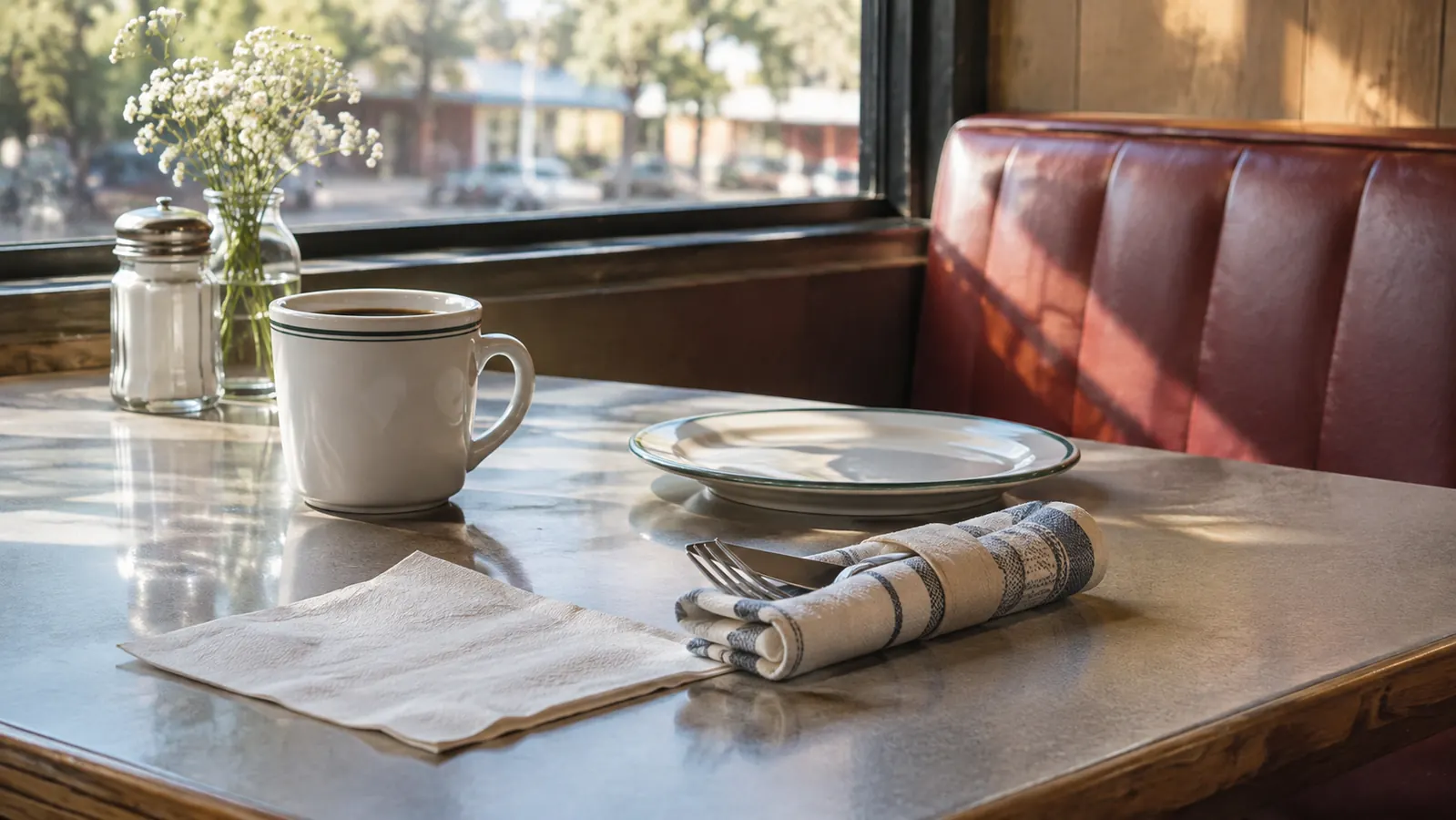
The set comes with a roll-up travel bag and mine lives in my purse. On Sundays we go to the diner on the corner and Walt brings his own spoon. The first time he did it he was self conscious about the whole business. Two months in, the waitress asks him where he got it, and a man at the counter asked to look at it. Restaurant flatware is thin, and thin is the worst thing you can hand a shaky hand.
We did end up with a second set after the first year, not because the first wore out but because the travel bag kept leaving the house with the soup spoon in it and the drawer at home would be one piece short. Two sets means one stays home and one stays in my purse. If you are on the fence, one set is fine. If your husband eats out more than once a week, two sets will save you an argument.
At home the set goes in the dishwasher basket with everything else, and it has held up fine for over a year. Polished stainless will spot if you leave it wet, so I dry the soup spoon by hand, mostly because it is the one we use most and I want it ready. Keep the whole set together in one drawer. When the fork is in the wrong drawer, the system falls apart at seven in the morning and you are back to the drawer of mismatched spoons.
What Else Helps
The utensils are one piece of a bigger setup, and I would be lying if I said they did all the work. A plate with a raised rim beats a flat plate every time. A heavier mug with two handles is easier than a teacup. Good light over the table matters more than you would think, because Walt eats better when he can see what he is doing. And a chair at the right height, so his elbows sit near the table and he is not reaching down to his food, changes the whole angle of the meal.
There is a whole catalog of adaptive plates and cups out there, and some of it may suit your house better than it suited ours. We tried a divided plate with three compartments and Walt hated it, said it made him feel like a toddler at snack time. The raised rim plate he likes fine. You will not know which is which until you try, and you should not take my word for what your husband will tolerate. Ask him, and then believe the answer.
The other thing I would say is to bring this up with the neurologist and the physical therapist instead of working it out alone in your kitchen the way I did for the first month. Ours had suggestions I would never have thought of, and the physical therapist is the one who first said the word weighted to me. Ask about the timing of medication relative to meals while you are there. That is a question for the doctor, not for me and not for a review on a website. What I can tell you is what happened at our table. Walt eats with the family again. Thanksgiving was the reason I bought the set, and Thanksgiving is the reason I would buy it again.
Fourteen months in, the soup spoon is still the one we reach for
The four piece weighted set from Vincere Silverware, with the roll-up travel bag that goes to the diner every Sunday. Dishwasher safe, and heavy enough that Walt grumbled about it for about a week.
Amazon Check Today's Price on Amazon →