

The thump from the hallway is a sound I have learned to hate. Walt caught the toe of his slipper on the edge of the runner rug in February and went down on one knee, and for about four seconds neither of us said a word. He was fine. I sat down on the floor beside him anyway, because my legs had gone strange. What bothered me afterward was not the fall. It was the count. Our house has nine doorways, one long hallway, and a runner rug in the middle of that hallway that I had walked across ten thousand times without once thinking about it.
That is the week the Drive Medical rollator came in from the garage and stayed in. We bought it about two years earlier, after a near miss out on the sidewalk, and until February it lived by the back door for store trips and the walk around the block. Now it lives in the hallway. The Walker with Seat is a steel frame on four 7.5 inch wheels, with hand brakes, height adjustable handles, and a fold up back support that lifts off if he wants it off. Twenty pounds. I am the one who lifts it into the Buick, and I will not pretend that is nothing. It is also too wide for our half bathroom door, so that room is the one place in this house the rollator does not go.
The Walker That Ended Up Living in Our Hallway
Two years in, this is the one we still use every day, indoors and out. Steel frame, four 7.5 inch wheels, hand brakes, and a seat Walt uses when the hallway feels long. Holds up to 300 pounds, with handles that adjust from 31 to 37 inches.
Amazon Check Today's Price on Amazon →Here is the order I would do this in if a friend called tonight and said her husband had started grabbing at doorframes. None of it is medical advice, and I mean that plainly. Walt's neurologist and his physical therapist are the ones who decide what he should be doing, and the PT is the one who suggested a rollator in the first place. What follows is the house part. The house part is my department.
Step 1: Set the handles to his wrist crease, then put the tool away
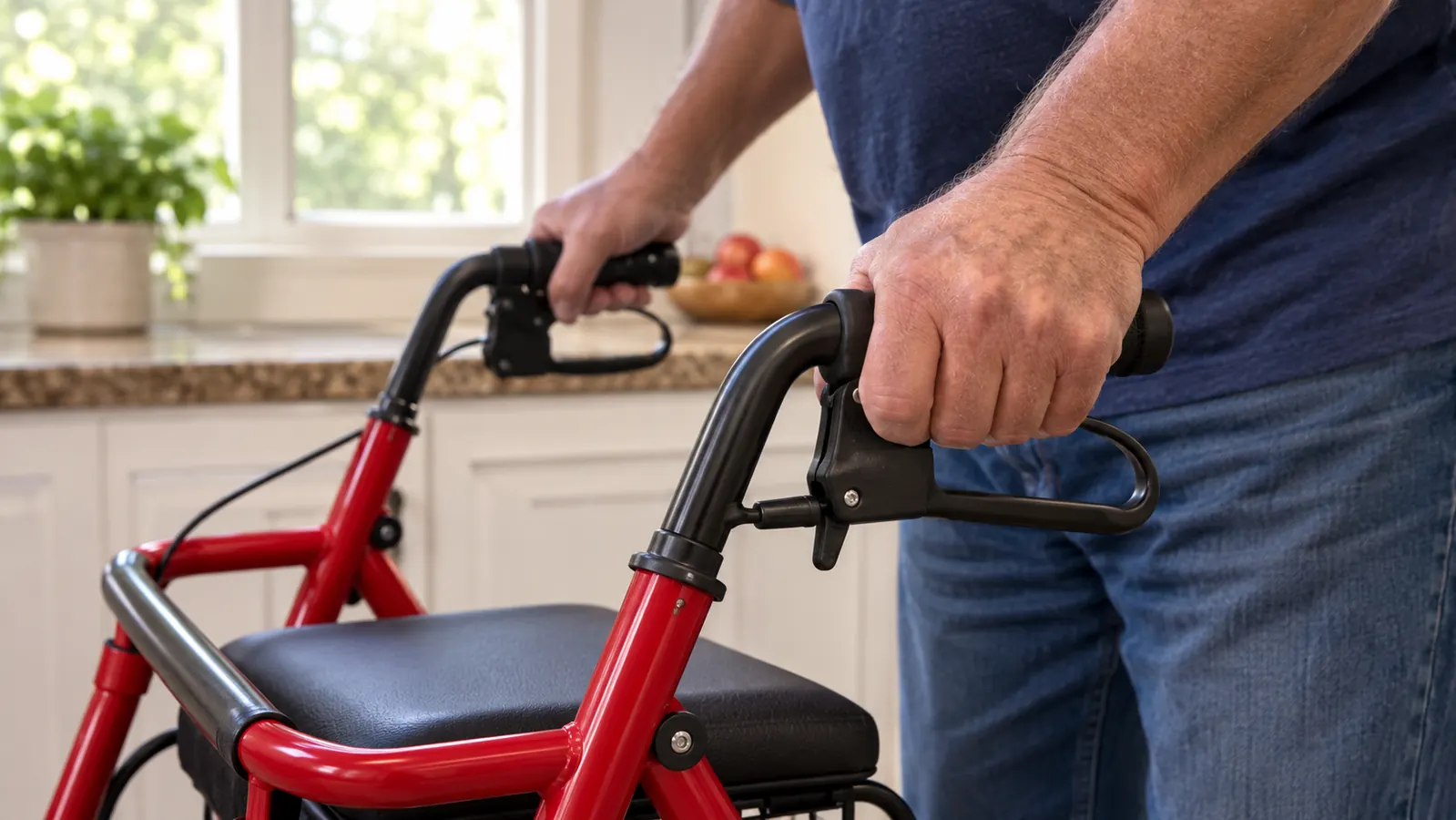
He stands inside the frame with both hands on the grips and his arms hanging naturally at his sides. The grip should land roughly at the crease of his wrist, with the elbows just barely bent. The handles on ours adjust between 31 and 37 inches with a lever on each side, and the right setting for Walt sits a little above the middle of that range. Ask the physical therapist to look at it once. Then stop touching it.
We spent two weeks fiddling before that. Walt would raise one side, decide it felt wrong, lower the other, and shuffle off with his shoulders up around his ears. Too low and he stoops, which makes the shuffle worse. Too high and he reaches, which pulls him off balance in the other direction. The correct height is boring and forgettable, and boring is what we were after. I put a strip of masking tape on each leg so I can see at a glance whether a handle has slipped after the rollator has been folded and unfolded into the car a dozen times.
Folding it matters more than I expected. The frame folds flat, the back support lifts off, and the whole thing weighs twenty pounds, so getting it in and out of the Buick is a two hand job with a pause in the middle. If you are the one doing the lifting, bring the seat side toward you and take it slowly. I have pinched my fingers in the fold more than once and I have learned to keep them clear of the hinge.
Step 2: Walk the route at his speed and count the turns
One afternoon I followed Walt through the house with a notepad and wrote down every place he had to change direction. The kitchen to hallway threshold. The corner by the linen closet. The swing into the living room. Four turns, and three of them were places where he stopped, planted his feet, and lifted the front of the rollator instead of rolling it. Lifting is how people tip a four wheel walker over, and it is how they lose confidence in it.
Turns need room. Our hallway is narrow enough that the Drive Medical rollator has to be swung around with both hands rather than pivoted on the spot, so I cleared the space it needed. The console table by the front door moved to the other wall. The runner rug went into the closet, because a rug that slides is a trap and a rug that does not slide is still a bump. The floor lamp moved six inches, which sounds like nothing until you watch a 71 year old man try to steer around it with a walker and a tremor.
One more note on floors, because nobody told me. The rollator rolls easily on the kitchen tile and the wood floor in the front room. On the carpet in the bedroom it drags, and Walt has to push harder through the last six feet before the bed. That is normal, not a defect, but it is tiring, which means the bedroom is where he is most likely to skip the walker and hold the wall instead. So we keep that path short and the wall clear of furniture, and I do not fuss at him when he holds the wall. I would rather he hold the wall than the air.
Step 3: Teach the brakes before you teach the seat
The seat is the reason we bought this model and the reason I nearly got it wrong. A rollator with a seat invites a tired man to sit down, and a tired man does not always remember that the wheels are free. The rule in our house is brakes first, both hands, then sit. The hand brakes on the Drive Medical squeeze and lock, and Walt sets both of them every time now, even for a ten second rest. The first month, he sat without setting them and the whole thing rolled back a few inches under him. It scared him more than it hurt him, and it took another month to get his trust back.
The other thing I had to say out loud, twice, is that the fold up back support is not a backrest to lean on while seated. It folds down flat for storage and lifts up when he walks, and it is there to support his back while he is moving, not to take his weight while he rests. When he sits, he sits on the seat and puts his hands on the frame. He also does not sit for long. A rest is a rest. If he needs twenty minutes off his feet, he needs a chair with arms, and I will walk him to one.
Step 4: Build a landing zone at every place he sits down
The hallway was only half the problem. The other half was the getting up. Low, soft furniture is the enemy of a man with Parkinson's, and our living room couch is both. Eight months ago we added a stand assist frame that slides under his cushion and gives him a handle to push against. It does not lift him. It helps him do the lifting, which is the point. It also shifts on the cushion if it is not pushed back in properly, so I check it every few days, and I would tell anyone buying one to check it more often than that.
The kitchen chairs have arms, which matters more than it sounds. A chair without arms gives him nothing to push off, and pushing off a table edge is how tables get dragged and cups get spilled. If you are buying one thing this month and it is not a walker, make it a chair with arms for the table he eats at most often. We found ours at a secondhand shop and it has done more for his confidence at breakfast than anything with a warranty.
The bed got a rail on his side about ten months ago, a U shaped steel frame that straps under the mattress and is tested to 300 pounds. Setup took me maybe ten minutes on my own with no tools, and it ended the mornings where sitting him up took two tries and left my back complaining for the rest of the day. Night lights went into the hallway and the bathroom at the same time, because a man who is steady at noon is a different man at 2 a.m. Slippers with a back on them, not the slip on kind. Small things. They add up to a house that does not fight him.
Step 5: Practise the doorway pause in daylight, before you need it at 2 a.m.
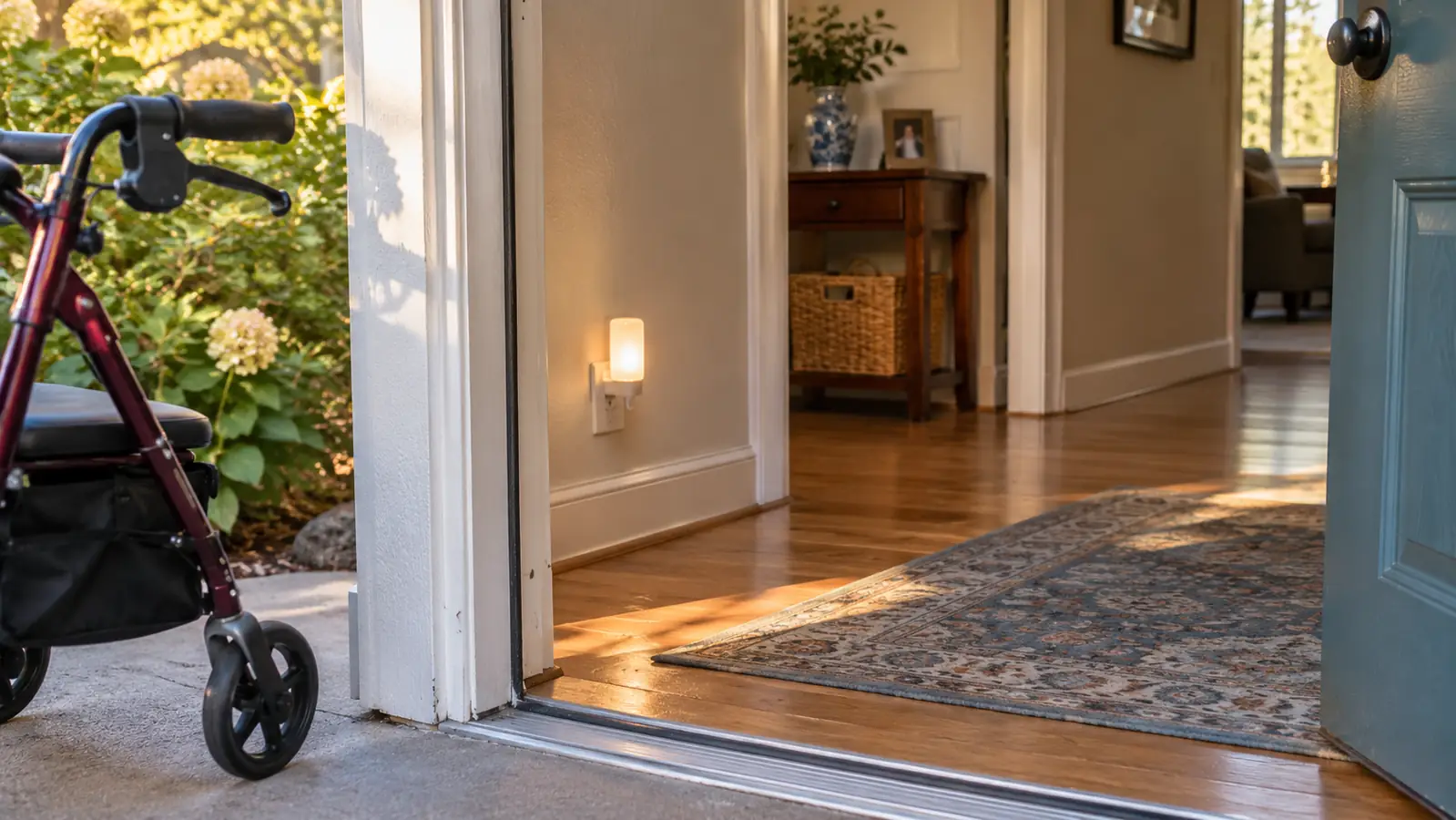
Freezing in a doorway is the part of this that nobody warns you about. Walt will be walking fine and then his feet simply stop, usually right at a threshold, and the more he pushes the more stuck he gets. The physical therapist gave him a routine and we practise it in the daytime, when it is still a little funny. Stop. Say the count out loud, three, two, one. Shift the weight to the back foot. Pick a spot past the door and look at that instead of at the door frame.
With the rollator, we do it in a set order. He rolls the walker through the doorway first, then steps through with one hand on the frame, then brings the other hand on. Trying to go through sideways with the walker held in front of him is what gets the wheels caught on the threshold strip. At night, when he is up and I am half awake, the pause is not funny at all, and he does it anyway because by now it is a habit and not a decision.
What Else Helps
The shower was the other place we had a scare. Standing in a wet stall on a shaky day is a bad combination, and Walt had started rushing through showers to get out faster, which made everything worse. We put an aluminum shower chair with padded armrests and a back into the stall about eighteen months ago, set the legs to his height, and added nothing else fancy. He washes himself. I stay nearby. The chair is rated to 350 pounds and the rubber feet do not slide on the floor of the stall.
The other things that helped were not equipment. A phone in his pocket instead of on the kitchen counter. A pair of shoes by the front door that he can step into without sitting down and wrestling with them. A second set of night lights that come on low and stay low. A short list on the refrigerator of who to call, printed large, because his handwriting has gone small and slow and mine is not much better.
And one more thing, said carefully, because I am not a doctor and I am not going to pretend to be one. None of this gear treats Parkinson's. The rollator does not make Walt steadier. It gives him something to be steady against, which is a different and smaller and very useful thing. If your husband or your mother is falling, or if the freezing is getting worse, that is a conversation for the neurologist and the physical therapist, and it should happen soon. The gear buys you a safer house in the meantime. It does not buy you time you do not have.
Twenty pounds of steel does not fix a shuffle. What it does is put a brake within reach of his hand and a seat four steps away when the hallway suddenly feels like a mile.
Start With the Hallway You Already Have
You do not need a new house. You need one doorway cleared, the handles set once and left alone, and a brake within reach of his hand. That is the whole job, and it can start tonight.
Amazon Check Today's Price on Amazon →