

You notice it in doorways first. Walt would come down the hall at his usual shuffle and then stop dead in the frame of the kitchen door, one hand on the trim, waiting for his feet to get the message. Seven years into Parkinson's, that freeze frightens me more than the tremor does. The tremor is honest. It announces itself. The freeze just happens, and then he is standing there working out how to take a step he has taken ten thousand times.
We bought a Drive Medical rollator about two years ago, after his physical therapist suggested one and after a near-fall out front that left us both quiet for the rest of the evening. It is a four-wheel walker with a steel frame, a padded seat, a fold-up back support and hand brakes. It did not fix anything. What it did was give us back the block, the grocery store, the diner on Sundays, and the long hallway between his chair and the bathroom at two in the morning. Here are ten reasons it earned its spot by the front door.
The frame that gave us back the block
Steel frame, four 7.5 inch wheels, a seat for the halfway point, and hand brakes he can reach without letting go. That is the whole list. It is not complicated. It just has to be steady.
Amazon Check today's price on Amazon →It gives him a rhythm to walk to instead of a shuffle
The shuffle is what wears him out. Small steps, no push-off, and by the end of the hall he is winded. Pushing a frame changes the job. His hands take some of his weight and his feet get a beat to follow, and I can hear the difference from the kitchen. I am not going to tell you it helps the Parkinson's itself. It gives him something steady to hold while he does the walking, and that is enough to get him down the hall and back.
The seat turns one long block into two short ones
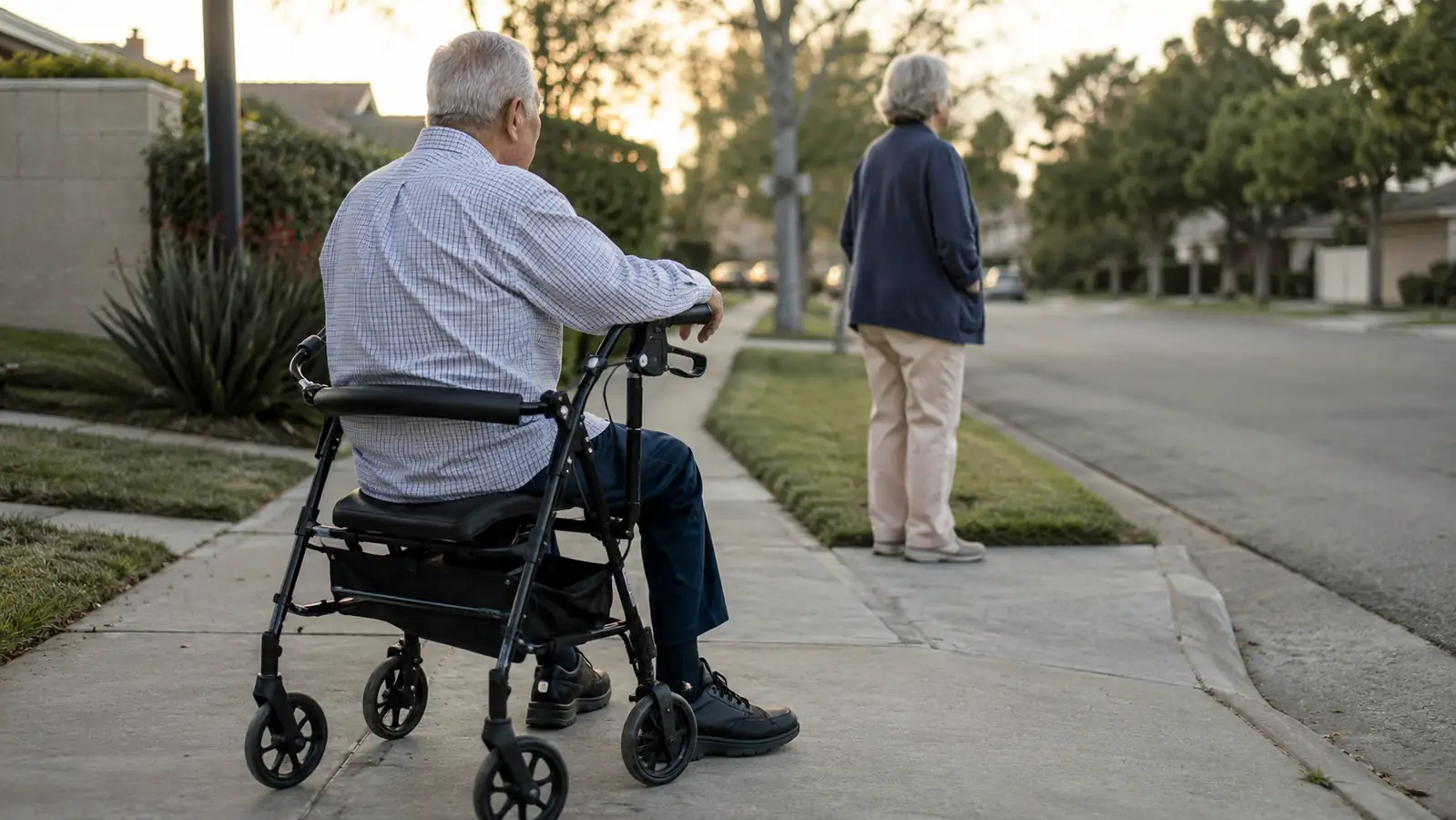
There is a stretch on our block with nowhere to sit. A curb, a fire hydrant, and a lot of grass. Before the rollator, Walt would turn around at the corner rather than risk not making it back. Now he gets halfway, sits down on the seat, rests a minute, and finishes the block. Same distance. Different attitude. He does not have to admit he needs a rest, because sitting is built into the walk instead of ending it.
Hand brakes let him stop on his own terms
A walker you have to wrestle to a halt is a walker he will not trust on a slope. The hand brakes on this one squeeze and hold, so when he feels his steps getting away from him on the sidewalk out front, he can stop and reset without me grabbing his arm. That matters more than I expected. Half the dignity of the thing is him being the one who decides when to stop.
The handles adjust from 31 to 37 inches, and that range matters
The Drive Medical rollator uses a height adjustment lever on the handles, and the frame runs from 31 inches at the low end to 37 at the top, with the recommended fit topping out at 35. Walt is not tall, but he stands with his shoulders rolled forward now, so we set the grips higher than I first guessed. Too low and he bends into the frame. Too high and he cannot push. It took us three tries over a week to land on the right notch. Once we did, his shoulders came down.
The back support folds up and comes off, so it does not read as a wheelchair
This was the whole negotiation. Walt would not be seen in anything that looked like a wheelchair, and I understood it. The back support on this rollator folds up and lifts off entirely, so on a good day it is a walker with a seat and nothing more. On a bad day we put the back on and he sits properly against it. He gets to choose how much help he is using on any given afternoon, and that choice is worth a lot to him.
He sits down halfway around the block, catches his breath, and then he finishes the block. Two years ago we turned around at the corner.
It fits our hallway, which is where the freezing happens
Freezing is a doorway problem in this house. The kitchen door, the bathroom door, the transition from carpet to linoleum. A frame that fits the hall gives him something to hold and something to look at besides the doorframe. Ours is a long hallway and the rollator passes through with room to spare. It is not going to unlock a freeze. It does mean that when the steps come back, he has support already under his hands instead of a wall he has to lunge for.
Four 7.5 inch wheels handle sidewalk seams and store floors
Small wheels catch on everything. Driveway lips, the metal strip at the grocery entrance, the little ridge between the sidewalk squares that has been tripping people since 1974. The 7.5 inch wheels on this rollator roll over those seams instead of stopping dead, and that means I am not walking ahead of him kicking at the pavement. It goes to the store, it goes to the diner, it goes around the block. It handles the ordinary ground he actually walks on.
It carries things, so I am not the pack mule anymore
The seat is flat and padded, and the frame gives you somewhere to set things down. His glasses case rides there. The mail rides there. When we are out, my tote bag rests on the seat while we wait for a table at the diner. That sounds small. It is not small. For two years I was the one carrying both of our things plus holding a door, and there is a particular kind of tired that comes from being everyone's extra set of hands.
Twenty pounds is light enough for one person and heavy enough to notice
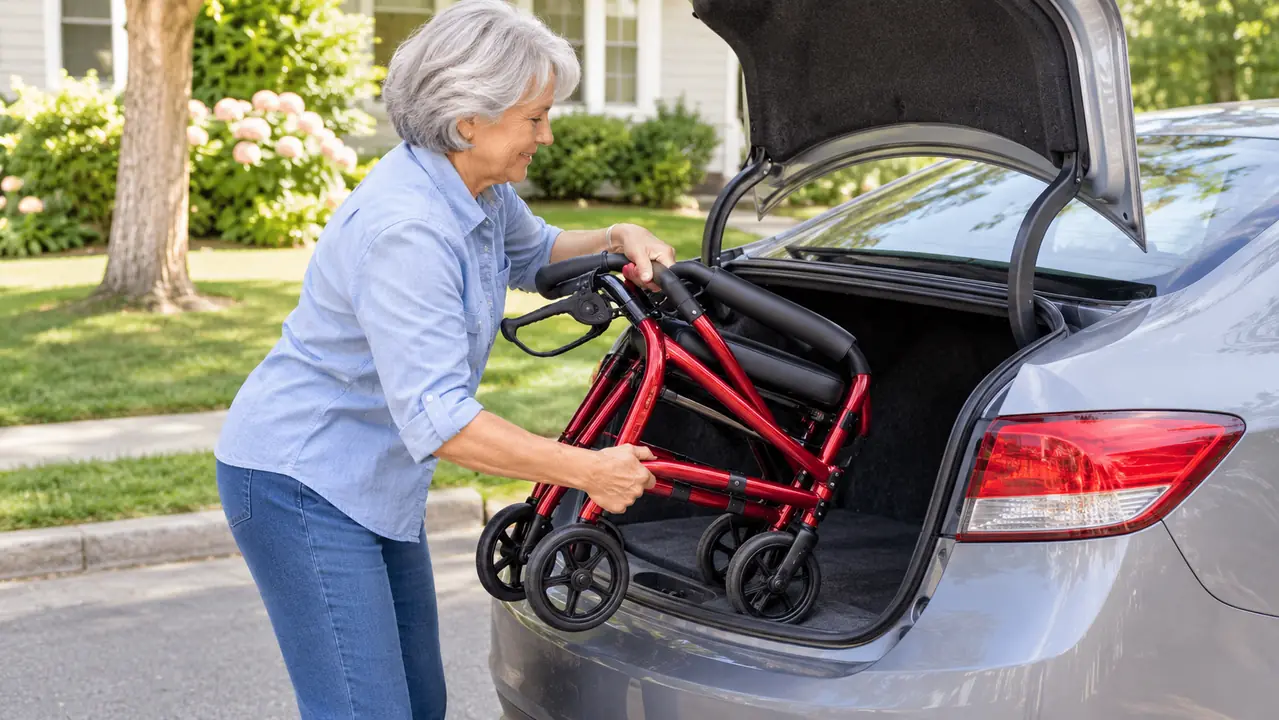
The Drive Medical rollator folds and weighs about 20 pounds, and I lift it into the Buick trunk myself. I want to be straight with you about that part. Twenty pounds does not sound like much until it is above your waist and behind a bumper. It is a workout. I do it anyway, and I have gotten better at it. If you have back trouble of your own, plan for that before you buy, or have someone along who can do the lifting.
A 300 pound weight capacity means I stopped doing math in my head
Every time Walt leaned hard on a kitchen chair, I ran the numbers in my head and did not like the answer. This rollator is rated to 300 pounds, on a steel frame, and it comes with a limited lifetime warranty. That is not a feature I thought about before we owned one. It is the one I think about now. When he puts his weight down, the thing holds. I do not have to hover, and he does not have to feel me hovering.
What I'd Skip
If you are picturing one piece of equipment that solves the whole house, skip that idea now and save yourself the disappointment. The rollator is too wide for our half bathroom door, so it stays out of that room, and Walt uses the doorframe and the sink instead. It does not get him up out of a low chair or off the couch, which is a different job and a different tool in our house. And it does not stop a freeze. There are afternoons when he is holding the grips and still cannot take the next step, and we wait it out together.
I would also skip buying one without talking to the neurologist or the physical therapist first. Ours was the one who told us what height to aim for and how to stand behind it, and that advice was worth more than any product page. If Walt's balance changes, we go back and ask again. Gear does not treat Parkinson's. It just makes an ordinary Tuesday at home a little steadier, and in this house that has been plenty.
Two years in, it still lives by the front door
The Drive Medical rollator is not a cure and it is not a wheelchair. It is a steel frame with four wheels, a seat for the halfway point, a back support that comes off, and brakes that hold. That was enough to get Walt around the block again.
Amazon Check today's price on Amazon →