

The first time I heard Walt's bare feet slide on the shower floor, I was standing in the doorway holding a towel and trying not to say a word. He had been diagnosed about five years before that, and showers had become the part of the day I could not stand outside of. Standing made him shaky, so he hurried. Hurrying is how a man with a tremor ends up on a tile floor at sixty-nine years old.
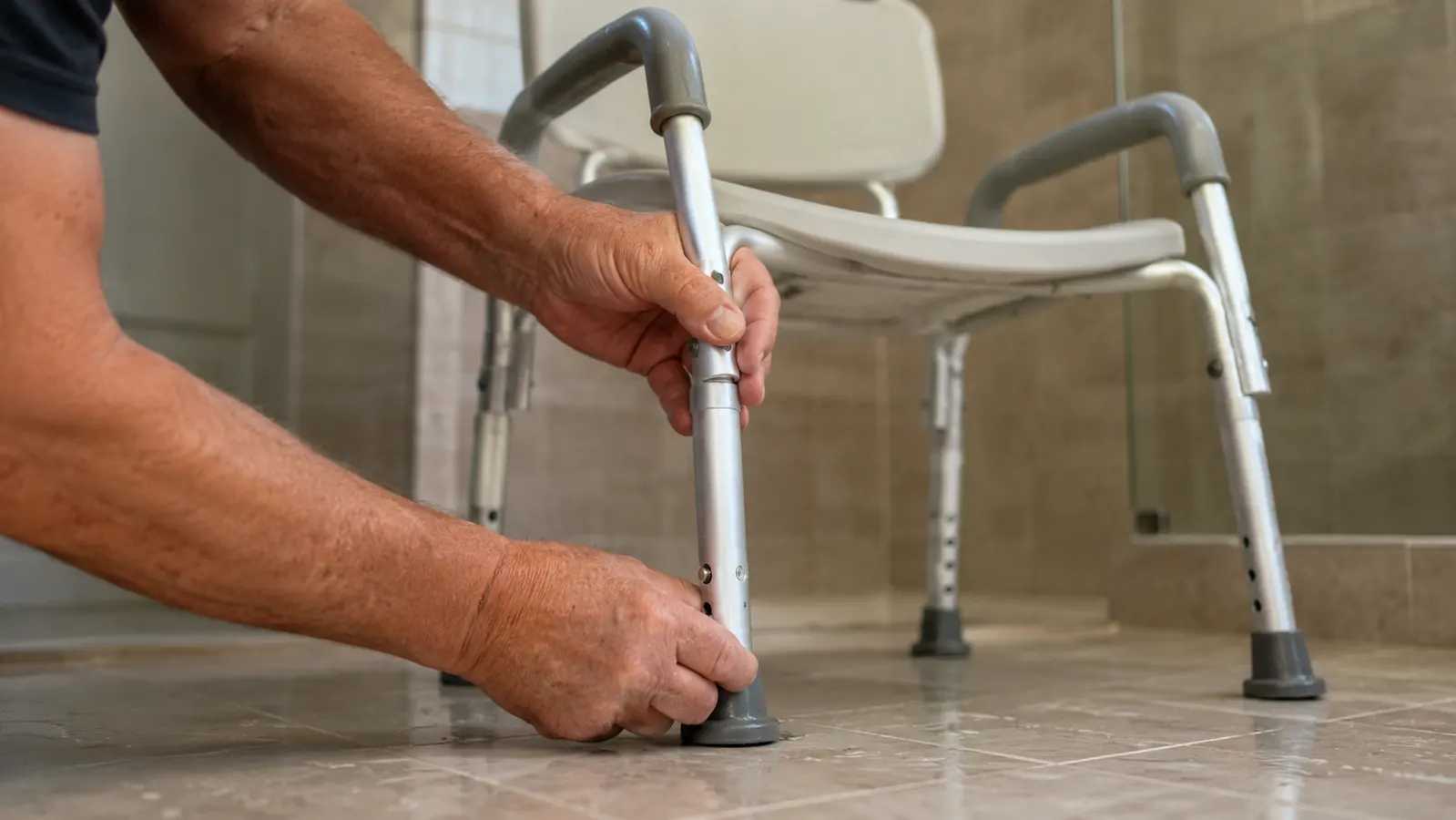
We bought the Medline shower chair about eighteen months ago, and it changed that hour more than I expected it to. I want to be honest about what it is and is not. It is a chair: lightweight aluminum, padded armrests, a padded back, six height positions. It does not treat anything. Walt's Parkinson's is still Walt's Parkinson's, and no piece of bathroom equipment is going to change that. But sitting down let him stop rushing, and stopping the rush fixed about half of what had been scaring me. The other half was the order we did things in, which I had never once thought about until our physical therapist started asking me questions.
The chair that let him stop rushing
Medline Premium Shower Chair with Back and Padded Armrests. Aluminum frame, six height positions, 350 pound capacity, and rubber feet that stay where you put them. Ours has been in the stall for eighteen months.
Amazon Check Today's Price on Amazon →Five Steps That Made Showers Safe Again
None of this is complicated. It is the kind of thing you figure out slowly and then wish someone had told you at the start. If your situation looks like ours, a walk-in stall, a spouse who still wants to wash himself, and a caregiver who would rather not be in the room, this is the order that worked.
Step 1: Fit the Chair Before the First Shower, Not During It
I set the Medline chair up on a Sunday afternoon with the manual open on the bath mat. It took about fifteen minutes and no tools beyond a Phillips head that was already in the kitchen drawer. Before I did anything else I got the tape measure out, because the chair stands 33.7 inches tall at the back and our shower head bracket hangs lower than I remembered. It cleared, but only just, and I would much rather find that out in an empty stall than with a wet husband in it.
Then the height. The chair has six positions and the gap between the right one and the wrong one is not a small gap. My first attempt at this whole business, months before we bought anything, was a folding plastic stool from the garage, and it failed for a reason I did not see coming. It had no back and no armrests, so Walt had nothing to push against when he wanted to stand again, and he ended up leaning one wet hand on the shower wall to get up. The Medline chair has padded armrests on a rolled arm and a contoured padded back, and that is the difference between a stool and something he can push himself out of.
Here is the test I used to set it. Walt sat down with both feet flat on the shower floor and I looked at his knees. Knees higher than his hips meant the seat was too low and standing up would have been a fight. Feet not touching the floor meant it was too high and sliding off was the risk. We landed two notches up from the bottom, which put the seat at 21 inches, and I stuck a strip of tape on the back of the chair with that number written on it so neither of us has to guess after I pull it out to scrub the stall.
Two details earn their keep more than they sound like they would. The rubber feet grip a wet floor and keep the legs where you set them, which matters more than any line on the box. And the whole chair weighs 7.1 pounds, so I can lift it out of the stall with one hand when I clean behind it, and I do that about once a week.
Step 2: Stage Everything Within Reach Before He Sits Down
The biggest change in our bathroom was not the chair. It was me putting a stop to reaching. Bending forward for a bottle of shampoo is the exact motion that tips a person with Parkinson's off balance, and we were doing it eight or ten times a shower without either of us noticing.
So now the shower is staged before he steps in. Washcloth, soap, shampoo, and the towel all sit at shoulder height or lower, spread across a small shelf and the grab bar. Nothing on the floor. Nothing behind him. The handheld shower head we already owned hangs in its bracket where he can reach it while sitting, which is the entire reason a handheld head and a shower chair belong in the same sentence.
The last thing I do before he steps in is run the water and let him test the temperature with his own hand. Not because I cannot judge it, but because his hands are his, and a man who has had a say in the water temperature is a man who is not startled.
Step 3: Make Getting In the Boring Part
Walt freezes in doorways. Ours is a walk-in stall with a low lip rather than a tub, and that lip has been enough to stop him cold on more mornings than I can count. The freeze is not stubbornness. His feet simply stop taking the instruction.
What helped was a routine that never varies. He comes down the hall with the rollator and leaves it outside the bathroom door, because four rubber wheels on a wet tile floor is a combination I am not willing to test. I laid a strip of painter tape on the tile where the rollator parks, so he has a target to aim for and does not drift past it. Then he takes the last six feet slowly, one hand on the door frame and one on my forearm, and he says the word out loud before he lifts his foot over the lip. Saying it out loud gives his feet something to follow.
If he freezes halfway, I do not pull him. Pulling a person mid-freeze is how a caregiver's back goes out and how a fall happens. I wait, he shifts his weight side to side a few times, and usually the step arrives on its own. One Tuesday last winter it did not arrive for a good ninety seconds, and the only thing that got us moving was me stepping back and giving him room instead of hovering in his face. If it still will not come, he sits down on the closed toilet lid and we try again in five minutes. Nothing about a shower is urgent enough to rush a freeze.

Step 4: Sit for the Whole Thing, Including the Parts He Thinks He Can Stand For
Walt washes himself. That was not negotiable for either of us, and the chair is what lets him keep doing it. He sits, and he stays sitting, including for his hair, which is the part he used to stand up for and the part that used to make me nervous from the doorway.
The padded armrests turned out to matter more than I expected. He rests his forearms on them when his right hand starts jumping, waits for it to settle, and then carries on. The padded back means he can lean back and take a breath in the middle without his shoulders working the whole time just to hold him upright. The first week I hovered and he hated it. By the second week I had learned to sit on the closed toilet lid with a magazine I never actually read, close enough to hear him and far enough that he did not feel watched. That arrangement has held for eighteen months.
Two small workarounds. We swapped the bar soap for a pump bottle he can hit with the heel of his hand, because a wet bar of soap and a tremor is a comedy routine neither of us enjoys. The pump bottle sits on the shelf at shoulder height, not on the shower floor, for the same reason. And we do the shower in the same order every time: face, chest, arms, legs, hair last. Same order means he does not have to plan anything while he is wet and getting tired. The one exception is a heavy tremor day, when we flip it and he does his hair first while his hands are still fresh, then rests before the rest.
Step 5: Treat the Ten Minutes After as the Risky Part
Everyone worries about the shower itself. The falls I hear about from other caregivers happen afterward, when the person is tired, wet, and in a hurry to be dressed. Warm water relaxes everything, including the muscles that were holding him steady, and the walk back to the bedroom is the longest walk of his day.
So he dries off sitting down. All of it, feet included, one foot at a time, lifted onto a towel across his knee. Then he stands with both hands on the armrests, finds his balance, counts to five, and only then reaches for the grab bar. The bath mat is the first thing my foot touches when I walk in there, and it does not get moved.
The chair stays in the stall. It does not get folded into a closet and it does not come out for special occasions. If it is not already there, he will not ask for it, because asking is the part that costs him something.
What Else Helps
Two things did as much work as the chair did. A grab bar, anchored into the studs by someone who knows what a stud is, which is not me. And a handheld shower head, which we already had and which I would have gone out and bought that same day if we had not.
Beyond those: a non-slip mat inside the stall and a bath mat outside it, a towel hook at shoulder height instead of over the door, a nightlight for the trips at two in the morning, and a second chair in the bathroom so I have somewhere to sit while he takes his time. Our bathroom is small enough that every one of those had to earn its spot, and none of it is decorative. I check the rubber feet on the shower chair every couple of months by pressing a thumbnail into one. Rubber that has gone hard is rubber that will slide, and it is a cheap part I would rather replace than think about.
The grab bar is the one job I did not do myself. I marked the spot I thought was right, then paid a handyman to find the framing and bolt it in, and he moved my mark four inches lower because of where the studs actually ran. That is exactly why I did not do it myself. A grab bar that pulls out of drywall when a grown man puts his weight on it is worse than no grab bar at all, because he will trust the next one less.
One more thing, and I mean this plainly. I am not a nurse and I do not play one at the kitchen table. If your husband or wife has new freezing, new balance trouble, or tells you the shower feels different than it did last month, that is a conversation for the neurologist or the physical therapist before it is a conversation about equipment. Ours is the one who told me to put a chair in that stall in the first place, and she was right.
Eighteen months, three or four showers a week, and no falls. The chair is not the reason. The order is the reason, and the chair is what makes the order possible.
Start with the chair and the grab bar. The rest can wait a month.
Medline Premium Shower Chair with Back and Padded Armrests. 350 pound capacity, six height positions, 7.1 pounds, and a one year limited warranty. Eighteen months in our stall at three or four showers a week, and the rubber feet are the only part I have had to keep an eye on.
Amazon Check Today's Price on Amazon →