
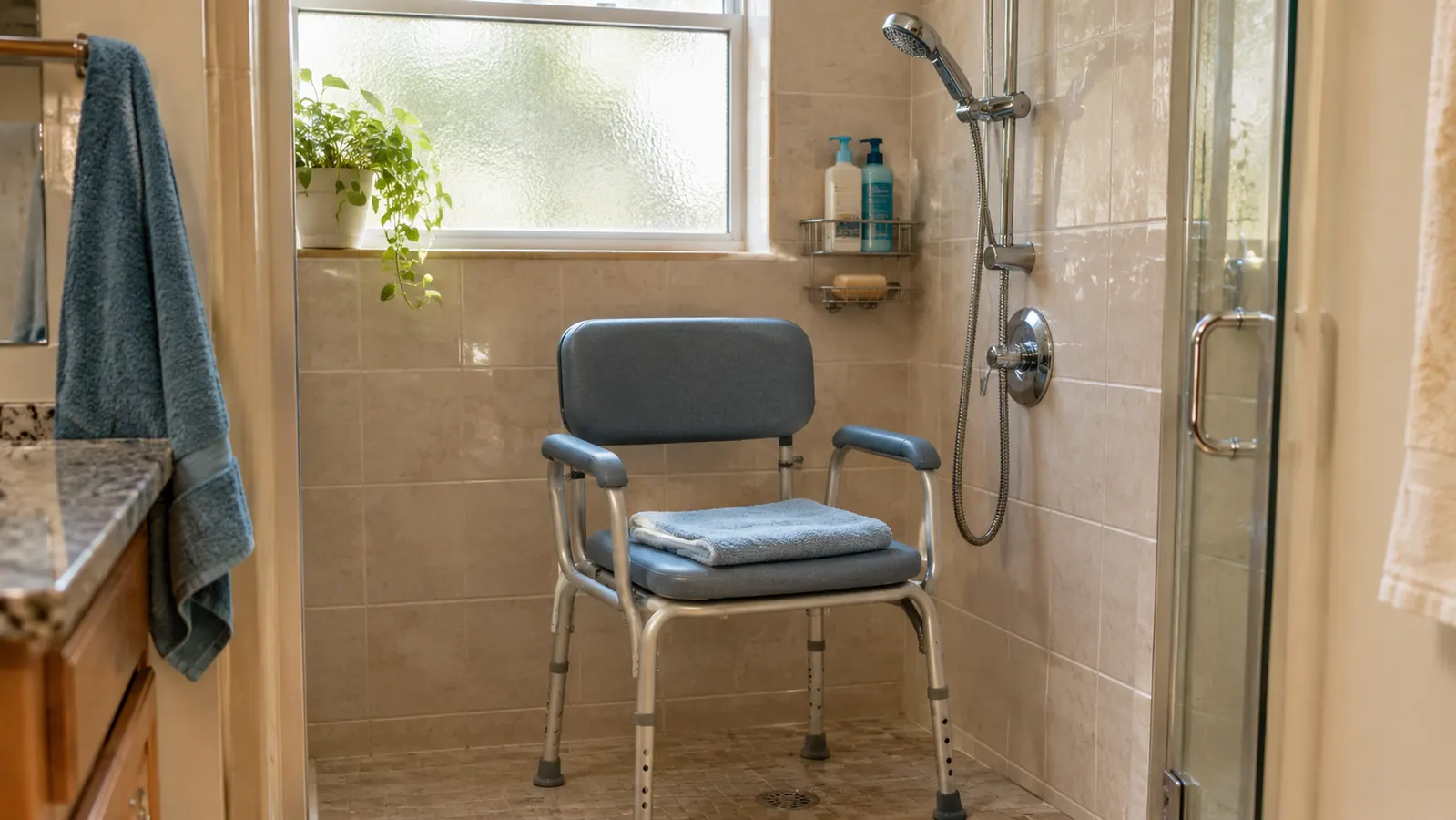
The short answer is that we bought the Medline and I would buy it again tomorrow. My husband Walt has had Parkinson's for seven years. What finally pushed us into a shower chair was not a fall. It was the sound of him rushing a shower because standing felt unsteady, and the way he sat on the edge of the bed afterward with his right hand shaking harder than usual. The Medline Premium Shower Chair has padded armrests, a padded contoured back, six height positions and a 350 pound capacity. The arms are the part that changed our mornings. A Drive Medical shower chair is a real option and it costs less. It is simply the better chair for a different person.
So the whole comparison comes down to one question. Does the person using the chair need something to push against when they stand back up? If the answer is yes, the padded armrests on the Medline settle it and you can stop shopping. If the person is steady, showers alone, and only wants a seat so they are not standing on a slick floor, a basic Drive Medical bath chair does that job and leaves money for a handheld shower head. Walt needs his arms to stand. That is why the Medline is in our stall and the Drive listing stayed on my laptop. Below are the measurements we took, the details that decided it, and an honest account of where the Drive chair is the smarter buy.
| Medline Premium Shower Chair | Drive Medical shower chair | |
|---|---|---|
| Armrests | Padded on both sides, and they are what Walt pushes on to stand | Most Drive models have none, and only a few in the line have arms |
| Backrest | Padded and contoured | Some models have a back, some are backless benches |
| Height settings | Six positions, seat height listed at 21 inches | Adjustable legs on most models, number of positions varies |
| Weight capacity | 350 pounds | Varies by model, and several are rated lower |
| Chair weight | 7.1 pounds, aluminum and rust resistant | Varies, and the steel frame models are heavier |
| Fit in a small stall | Needs 16.3 inches of width plus room to swing the arms | A backless bench fits a stall where the Medline would crowd |
| Range of models | One chair, one configuration | Benches, chairs with backs, and transfer benches |
| Assembly | Ships with a step by step manual | Varies by model |
| Warranty | One year limited | Varies by model, check the listing |
| Upfront cost | Costs more than the basic Drive models | The Drive line includes the lower cost options |
| Best for | Someone who needs to push up on arms and sit back against padding | A steady person who needs a seat, or a very small stall |
Where Medline Wins
The armrests are the reason I am writing this. Walt sits down with his back against the padded back, showers, then plants both palms on the armrests and pushes himself upright. Before we had arms, he walked his hands along the shower wall to get up, and on a tired day that meant two tries and a wet palm sliding off the tile. The arms are padded and rolled, and his hands wrap around them instead of pressing flat, which matters when the tremor is bad and his grip is not what it was. Four showers a week, eighteen months, and he has not once asked me to pull him up out of that chair.
The rest of the chair holds up in quieter ways. It is aluminum and rust resistant, and after eighteen months in a wet stall there is nothing blooming on the frame, which I cannot say for the metal shelf above our washing machine. It weighs 7.1 pounds, so I lift it out with one hand when I scrub the shower floor. The frame is rated to 350 pounds, well past what we need, and the slip resistant rubber feet keep the legs where I put them instead of skating toward the drain. There are six height positions. Medline lists the seat height at 21 inches and the seat itself at 15.8 inches by 13.1 inches, and the back is contoured rather than flat, so it meets his shoulder blades instead of poking them. One year limited warranty, and a step by step manual in the box, which I read once and did not need again.

Where Drive Medical Wins
Drive Medical wins on cost and on choice, and I am not going to pretend otherwise. The Drive line runs from a plain backless bench to chairs with a back and everything between, so there is a version for almost any bathroom and almost any budget, and the entry models cost less than the Medline. In a bathroom the size of a closet, a small backless bench fits on the floor and leaves room to move. The Medline, with arms and a back on a 16.3 inch wide frame, wants more elbow room than that. If you have a tight stall and a person with good balance, the smaller chair is not a downgrade. It is the right tool. I have not showered in a Drive chair myself, so I am going by the listings and by two I have seen in friends' bathrooms. Treat the details as a starting point and check the exact model you are buying.
Second, Drive Medical is not the brand you settle for. We own a Drive rollator, the four wheel kind with a seat, and it has carried Walt around our block for two years without a complaint from either of us. Same company, different job. The reason the shower chair went the other way is narrow and specific. The lower cost models do not have arms, and arms are the entire point for a man who has trouble rising from a low seat. If your husband or your mother can stand up off a bench on their own, you do not need to pay for armrests. Buy the simpler chair, add a handheld shower head, and put the difference toward a grab bar installed by someone who knows what is behind the tile.
If standing up is the hard part, the arms are the whole reason
Padded armrests on both sides, a padded contoured back, six height settings, 350 pound capacity, and 7.1 pounds of rust resistant aluminum. One year limited warranty.
Amazon Check Today's Price on Amazon →How We Ended Up With One in the Shower
Our physical therapist was the one who put the word adaptive in my head, back when Walt was still doing hallway walks with a gait belt. I ignored the idea for a while, partly because a shower chair felt like a statement about how bad things had gotten. It was not a statement. It was a chair. Then came a stretch of mornings where he stood in the shower with both hands flat on the wall and finished in four minutes because standing had become the exhausting part. He was not falling. He was rushing, and rushing in a wet stall is how a fall happens later.
The filter was simple. Arms, a back, aluminum so I could move it, and a capacity rating with room to spare. That cut the list down fast. Walt saw the difference in cost between the Medline and the basic bench and told me I was buying a Cadillac for a shower. He used it that first night without a word. The first two weeks he grumbled that it made him feel like a hospital patient, and then he stopped grumbling and started setting his own towel on the seat before he got in. I pull the chair out of the stall every Saturday to scrub the floor, and it goes back in with one hand.
He plants both palms on the padded arms, pushes, and stands. Four showers a week for eighteen months, and I have not had to haul him up once.
The Parkinson's Details That Decided It
Parkinson's is not one problem, so the chair had to answer more than one. The tremor is worse when he is tired, which means the evening shower is the risky one, and a shaking hand does not grip a flat wall the way it grips a rounded armrest. The shuffling steps mean he does not lift his feet as high as he thinks he does, and the rubber feet on the chair keep it planted while he turns to sit down. The freezing happens in doorways more than anywhere else. The chair does nothing about that, but having a defined place to sit two steps inside the stall gives him a target instead of a stretch of open tile.
The getting up part is what sold me. A bench without arms asks a person to slide forward, plant their feet, and use their legs alone, and Walt's legs are not the reliable part anymore. On the Medline he slides forward, puts his hands on the armrests, and lets his arms do the first half of the work while his legs catch up. That is the difference between a chair he uses and a chair he avoids. The six height settings matter here too. We set it so his feet sit flat on the floor and his knees are not higher than his hips, which took two tries and one wet afternoon of adjusting with a wrench.

Fit, Measurements, and the Bathroom Door
Measure before you buy. The Medline footprint is 16.3 inches wide by 13.4 inches deep, the overall height is 33.7 inches, and the seat is 15.8 inches by 13.1 inches with the height listed at 21 inches. Those numbers on their own do not tell you much. What matters is whether the chair fits between the shower walls with room for a person to sit and turn, and whether you can still reach the faucet and the soap without stepping around it. Our stall is a walk in with no tub and a handheld shower head already on the wall, so the chair sits at the back and the hose reaches fine.
The doorway is the other measurement. Our half bathroom off the hall has a door too narrow for the rollator, so that room is not part of the shower routine and never will be. The main bathroom opening is wider, and the chair stays inside it. If your bathroom has a tub rather than a stall, a chair with arms and a back may not clear the tub wall from the outside, so measure the transfer, not just the floor. If someone has to step over a tub rail to reach the seat, the answer may be a transfer bench rather than a shower chair. Ask the physical therapist about the whole routine before you buy anything.
What Neither Chair Does
Neither chair treats anything. Parkinson's is not a balance problem that a piece of bathroom furniture solves, and no shower chair slows the disease down. What a chair does is remove one risky moment from the day, and there are other risky moments I have not solved. It does not stop the freezing in the hallway, it does not help him out of the Buick, and it does nothing at all about the handwriting. It also does not replace the neurologist or the physical therapist. I am a retired school office manager with a notebook and a measuring tape, not a clinician. Before we changed anything in that bathroom, we asked. You should too.
Who Should Buy Which
Buy the Medline if the person using it needs to push up on something to stand. That is the short version and it covers most Parkinson's households I know. It also suits anyone who wants a padded back, a chair they can lift with one hand, and a capacity rating of 350 pounds with room to spare. If the shower is a walk in stall, if there is a handheld shower head on the wall, and if the person showers three or four times a week with someone nearby, this chair does the job without drama.
Buy the Drive Medical chair if balance is not the issue and the shower stall is small. A backless bench takes less floor space, costs less, and gives a steady person somewhere to sit instead of standing on a slick floor. It is also the sensible answer if you are outfitting a bathroom for occasional use rather than every day. Just be honest with yourself about the standing up part. If you are not sure, watch them get out of a low kitchen chair one evening before you decide. That will tell you more than any listing.
Eighteen months in, the same chair is still in our stall
Padded armrests and a contoured padded back, six height settings, 350 pound capacity, 7.1 pounds, aluminum with a one year limited warranty.
Amazon Check Today's Price on Amazon →