

The first time I caught Walt rushing a shower, the water had been running about four minutes. He used to take twenty. He was not being efficient. He had started feeling unsteady on a wet floor with his eyes closed, and rather than say that out loud, he had decided the answer was to be quick about it. By the end of that January there was a Medline shower chair sitting in the stall of our walk-in shower, and I stopped listening for the water from the kitchen.
I am Marjorie Ellison. My husband Walt is 71, a retired machinist, and he was diagnosed with Parkinson's seven years ago. His right hand shakes worse when he is tired. His steps have gotten shorter and he freezes up in doorways now and then. Standing still in a wet shower is a hard job for anybody, and for Walt it had become the riskiest five minutes of his day. His physical therapist was the first person to use the words adaptive equipment with us, and she was right. It took me a while to stop thinking of a shower chair as giving in and start thinking of it as a piece of furniture that keeps my husband upright.
The Quick Verdict
Eighteen months of wet use and it has never wobbled, never rusted, and never made Walt feel like a patient. The padded arms are the reason to buy this one. The seat is shallow front to back, so measure before you order.
Amazon Check Today's Price →The five minutes of my day I finally stopped worrying about
Padded arms he can push up from, a contoured back, six height positions and rubber feet that stay flat on wet tile. This is the chair in our shower stall, eighteen months in.
Amazon Check Today's Price on Amazon →How I've Used It
The chair lives in the shower stall of the main bathroom. It is a walk-in stall with no tub, which made this decision simple, and we already had a handheld shower head on a slide bar from years back. Walt showers three or four times a week, usually after breakfast, and he washes himself. I sit on the closed toilet lid with a book I am not really reading. That is our arrangement. He keeps his dignity and I keep my peace of mind, and neither of us has to talk about it much, which is how he prefers things.
The frame is aluminum and the whole chair weighs about seven pounds, so I can lift it out of the stall with one hand when I want to scrub the floor, which I do every couple of weeks. The frame has not rusted. The rubber feet have not gone hard or slick. The padding on the arms has not split or started peeling at the seams. The seat and the contoured back take the daily wear, and both of them look close to the way they did the month we set the thing up. I check the joints the way my father taught me to check a ladder, which is to look at them and then stop looking. Back in March Walt said the chair felt different under him, so I got down on my knees with a flashlight and found a film of soap scum on the feet. I wiped them down with a rag and the feeling went away. That was the only scare in eighteen months.
Setup took about fifteen minutes with the manual that comes in the box, and most of that was me deciding which of the six height positions to use. We started in the middle. Walt sat down on a dry floor with his feet flat and his knees came up too high, so we went up a notch and tried again. If you are setting one of these up for somebody, do that part with them in the room. The number on the box will not tell you where their knees want to be.

What the Padded Arms and Rubber Feet Actually Do
The padded arms are why I would buy this particular chair again instead of a plain plastic stool. Walt does not lower himself into it so much as reach back and down and find the arm, usually with the shaky right hand, and take some of his weight through it. A rolled padded arm gives him a dry, solid thing to hold that is not a wet tile wall and not my shoulder. Before the chair we tried a plastic stool I found in the basement, the kind with no back and no arms. Walt used it twice. The second time he reached for the wall to steady himself, got the shower curtain instead, and the rod bent. That was a Tuesday, and by Friday I had ordered the chair. When he is finished he pushes up off the same two arms. That is the whole trick of the thing, and it is why I would not trade the arms for a wider seat.
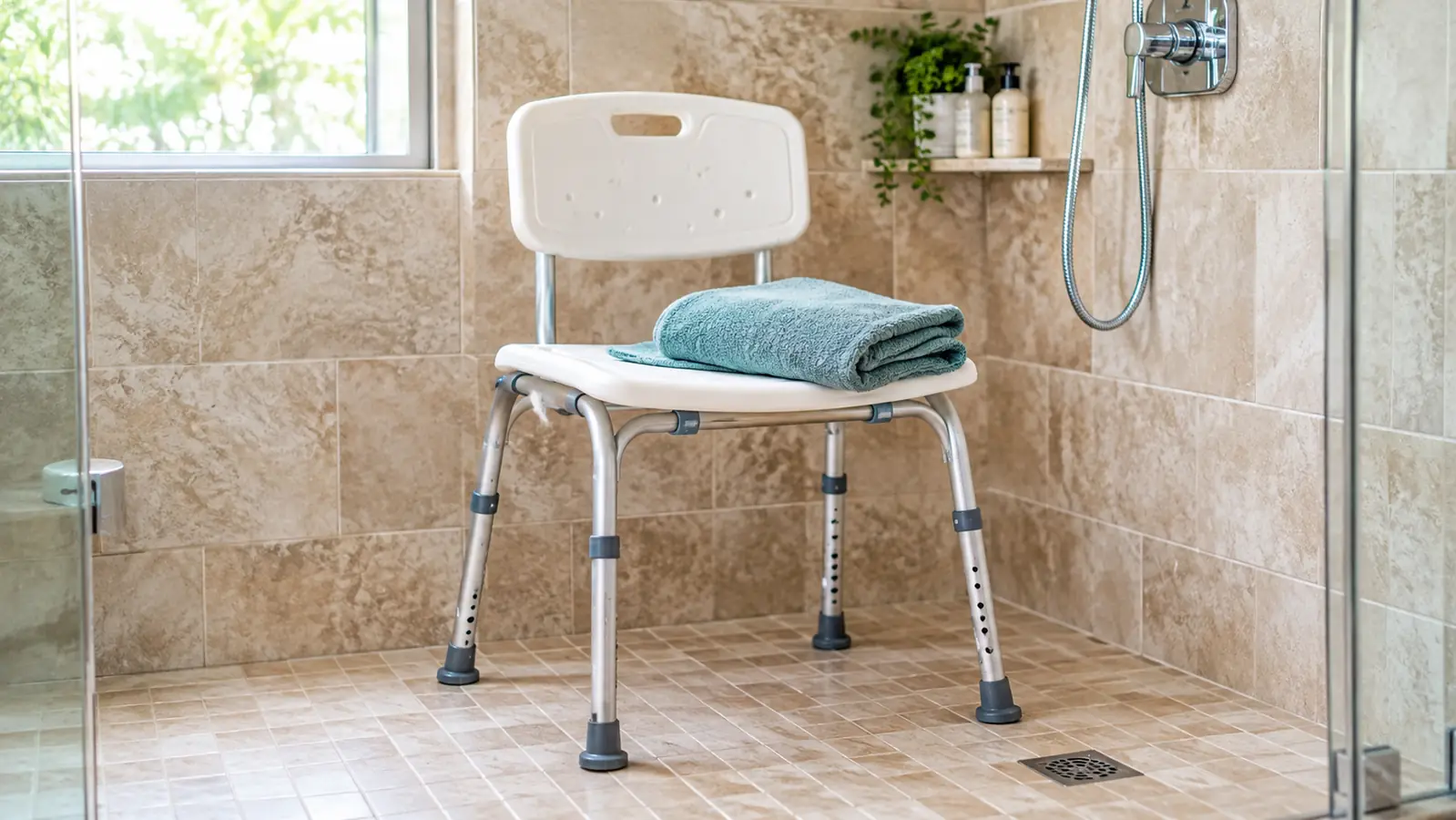
The feet are slip-resistant rubber and they are the first thing I check when I clean the stall. Four flat pads sitting on the tile, and the chair does not walk when Walt shifts his weight. The listing rates the chair to 350 pounds. Walt is nowhere near that, so we have margin, which is how I like my equipment these days. The straight legs sit square in the stall with no wobble, and I have never once had to shim it or wedge a folded towel under a foot.
The back is contoured, so it holds him a little rather than letting him slump against a flat panel, and it is high enough that he can lean back between rinses. The footprint is listed at 16.3 inches wide and 13.4 inches deep, and that fits our stall with room on both sides. Our stall opening is 36 inches across, and I carry the chair through it with a couple of inches to spare on either hand when I take it out to scrub underneath. It is not a roomy chair, though. Anyone broad across the hips or long in the thigh should read those two numbers twice before ordering, because the seat is honest but it is not generous.
Eighteen Months In: What Has Held Up and What Has Not
Eighteen months and somewhere north of two hundred showers, and nothing has broken. I give the frame a once-over every few months and nothing has worked loose. The height setting has not slipped a notch on its own, and I know that because I wrapped a strip of masking tape around one leg at the height we settled on, back in the second week, and the tape sits exactly where it did. The seat has not cracked. The only change is cosmetic. The padding on the left arm has a faint shine where Walt's hand lands every single time, and the rubber feet have picked up a dull grey film from the tile, which seems fair enough for the work they do.
Cleanup is a spray bottle and a rag. I wipe the seat and the arms once a week and take the whole chair out of the stall every other week to scrub the floor underneath it. Water pools on the seat between showers, so I keep a folded towel on it. That is the least glamorous sentence in this review and also the most useful one. If you leave the seat wet, the next person sits down on a cold puddle and everybody in the house is unhappy for an hour.
The arms cut both ways. They are the reason the chair works for Walt and also the reason he has to step in from the front rather than slide sideways onto the seat. In a narrow stall that takes a little choreography, and the first week I hovered more than usual. The chair also eats most of the standing room in our shower, so there is no space beside it. None of that has been a deal breaker. All of it is worth knowing before you carry a box into the house.
What I Liked
- Padded arms give Walt a dry, solid place to push up from, which is the whole reason it works
- Aluminum frame at about seven pounds, light enough for one person to lift out of the stall
- Six height positions, set once with the person sitting in the chair so their knees land right
- Slip-resistant rubber feet have not hardened or slid in eighteen months of wet tile
- Rated to 350 pounds and it has never wobbled or walked on us
- No rust anywhere on the frame after daily wet use
- Wipes clean with a bathroom spray and a rag
Where It Falls Short
- Seat is shallow front to back, so a tall man ends up perching
- Water pools on the seat between showers and needs a wipe
- The arms mean you step in from the front, not slide in from the side
- Takes up most of the standing space in a small shower stall
- Not a lift. Walt still pushes up under his own power
He used to take four-minute showers because he was frightened in there. Now he takes twenty again, and the only thing that changed was a chair with arms.
What the Chair Does Not Do
It does not treat Parkinson's. It does not stop a freeze and it does not stop the tremor. Some mornings Walt's hand is bad enough that he wants help with the shampoo, and the chair has nothing to say about that. What it does is remove one specific danger from one specific room, and it does that every single time. I would not want anybody reading this to think a piece of bathroom equipment is going to change the disease. It changes the shower. That is enough for it to earn its floor space. There are mornings when the chair is the difference between a real shower and a sponge bath at the sink, and Walt would tell you he hates the sponge bath a good deal more than he hates the chair. That is his line, not mine, and he says it dryly, the way he says most things.
It is also not a lift. Walt pushes up off the arms under his own power, and that is the point. If your husband or wife cannot stand from a seated position even with arms to push against, this is the wrong piece of equipment, and the conversation you want is with the physical therapist about a powered option. The 350 pound rating is about weight, not about strength or balance. Those are three different questions, and only one of them is answered on the box.
Where It Fits With the Rest of Our Gear
The shower chair is one of five pieces of adaptive equipment in this house, and I have come to think of them as a set rather than a collection of gadgets. The rollator lives by the front door for walks around the block. The bed rail is on Walt's side of the bed for the mornings when sitting up takes two tries. The stand assist is tucked under his end of the couch. The weighted utensils are in a drawer by the kitchen table. The Medline chair is the only one of the five that lives behind a closed door, and it is the only one nobody outside this family ever sees.
That is worth saying plainly. The equipment people talk about is the equipment you can see. The bathroom gear is the equipment that quietly prevents the fall that would change everything. There was a morning in April when Walt stood up from the chair, reached for the towel bar, and missed it. Nothing happened. He sat back down, waited a minute, and tried again. Without the chair he would have been standing on wet tile with nothing behind him at all. I do not tell him that story, and I think about it every time I fold a towel. Our physical therapist raised the chair, not us, and I have since become the person who raises it with everybody else. If somebody in your house has started taking short showers or leaving the water off until the last possible second, that is the signal. It is not about getting old. It is about a wet floor and a body that does not balance the way it used to.
Who This Is For
This is for the household where somebody can still stand and walk but cannot safely stand still on a wet floor with their eyes shut. That was exactly our situation eighteen months ago, and Medline makes a chair that suits it without a lot of fuss. It is also for the caregiver who has been standing outside the bathroom door pretending to be busy folding towels. The chair lets you sit down and read. If you are on the fence, think about the last time somebody in your house was in the bathroom longer than you expected and you found yourself standing in the hallway listening. That feeling is the reason for the chair, and everything after it is just measuring. If there is a walk-in stall in the house and no tub wall to climb over, this one drops straight in, and the padded arms are the part that earns its keep.
Who Should Skip It
Skip it if the shower is over a tub. You want a transfer bench for that, something that straddles the tub wall and lets a person sit and swing their legs across, because this chair has to sit flat on the floor of a stall. Skip it if the person needs a safety belt or two people to move them, since that is a different class of equipment and a different conversation with the physical therapist. And if someone is very broad or very tall, measure the seat and the stall before ordering. Sixteen inches by thirteen is a real number, but it is not a big one.
Eighteen months, no rust, no wobble, no more four-minute showers
If a shower has become the riskiest room in the house, this is the quiet fix. Padded arms, contoured back, six height settings, rubber feet on the tile, and a one year limited warranty from Medline.
Amazon Check Today's Price on Amazon →