

The thing nobody told me before we bought a rollator is that the hard part is not the walking. The hard part is the doorway. And the living room rug. And the four inches of lip between the driveway and the garage floor.
I am Marjorie. My husband Walt is 71 and was diagnosed with Parkinson's seven years ago. About two years back he caught his toe on the driveway and went down on one knee, and that was the week the physical therapist's suggestion stopped being a suggestion. We bought the Drive Medical rollator with the seat and the 7.5 inch wheels. Steel frame, twenty pounds. I have since pushed it around the block, folded it into the trunk of a Buick, and cleaned a fair amount of diner coffee off the seat. So this is not a first-week review. This is what I wish somebody had sat me down and said.
The Quick Verdict
A genuinely steady, genuinely heavy four-wheel rollator that gave Walt his walks back. The seat is the whole reason we bought it. The width is the whole reason it does not go everywhere.
Amazon Check Today's Price →The seat is what turns a walk into something he will actually agree to
Walt sits on it halfway around the block. That single feature is the difference between a walk we finish and a walk we turn around from. Check the current price and the frame options.
Amazon Check Today's Price on Amazon →How We Actually Ended Up With This One
I want to be honest about how little research went into it, because I think that is how most caregivers actually buy these. The therapist said four wheels with a seat, not a two-wheel walker, because Walt's problem is not lifting his feet, it is steadiness and getting tired. She said get one with hand brakes. She said do not get the cheapest thing on the shelf.
So I stood in the medical supply aisle with my phone out, read about nine reviews, saw that this Drive Medical model had a fold-up back support and a 300 pound weight capacity and a limited lifetime warranty, and put it in the cart. That was it. Two years later I can tell you the parts of that decision that held up and the parts I would change.
What we tried first, in order, so you can skip some of it. A plain cane, which lasted about three weeks, because the tremor in his right hand made the grip unreliable and the cane did nothing at all about his balance. Then a two-wheel walker a neighbor lent us, the kind you lift and set down and lift again. Walt hated it because it made him feel like he was hauling furniture around, and by the second day he was carrying it instead of pushing it. The rollator is the first piece of equipment that did not make him feel worse than walking with nothing.

The Frame Is Steady and That Is Not a Small Thing
The steel frame does what steel does. It does not flex. When Walt leans on the handles, the rollator takes his weight and stays put. I have watched him put far more of himself into those grips than he should while turning around in the kitchen, and the frame has never once felt like it was going to tip or skitter.
The handles adjust from 31 to 37 inches of height, and there is a lever on each side so you can set them independently. We set them once, years ago, based on what the therapist measured, and I have not touched them since except once when our son visited and knocked them crooked getting the thing out of the trunk. The adjustment lever is the kind of thing you are glad exists and then never think about again, which is exactly what you want from a piece of equipment like this.
Twenty pounds, though. Twenty pounds is real. I lift it into the Buick trunk myself and I can do it, but it is a two-hand lift with a little grunt at the end, and on a bad-back week it is the worst part of going anywhere. If you have any shoulder or back trouble of your own, get somebody to help you think about that number before you buy.
The Seat, the Back Support, and Why Those Two Things Matter More Than Anything Else
Here is what I did not understand about walkers before all this. The person using it does not want to use it. Walt resented the whole idea for the first month. What changed his mind was not the steadiness, it was discovering he could sit down.
Halfway around our block there is a stretch of shade with no bench. Walt sits on that seat, catches his breath for two or three minutes, and then we finish. Without a seat we would be turning around at that point, and turning around at that point means the walk gets shorter every week until it stops happening. The padded seat is the reason the walks kept happening.
What changed his mind was not the steadiness. It was discovering he could sit down halfway around the block.
The back support folds up out of the way when he is walking and drops down behind him when he sits. It is removable too, though I have never taken it off. The seat itself is a firm padded slab, not soft, which is good because a soft seat on a rollator would make it harder to stand back up out of, and standing back up is already the hard part.
One honest note: the seat is for resting, not for sitting comfortably for half an hour. If Walt sits more than five minutes his back starts to complain, and I do not blame the seat for that. It was never sold as a chair. It is a place to stop.
The Wheels, the Brakes, and the Surfaces We Have Learned To Avoid
The 7.5 inch wheels roll smoothly enough on pavement, on the sidewalk, and on the tile at the grocery store. On our driveway, which is original 1970s concrete with some cracks, they do fine if Walt goes slow and I walk on his other side. In the yard, no. In gravel, absolutely not.
The gravel path at the park was a Sunday in October, roughly two years back, and we made it about fifteen feet. The front wheels sank and the whole thing wanted to go sideways, and Walt grabbed the handles hard enough that I thought he was going over. We backed out slowly, drove home, and I put the rollator in the trunk without either of us saying anything about it. On the tile at the grocery store it is the opposite story. It rolls so easily that I have to remind him not to lean his full weight forward, because on a polished floor it will get away from him, especially near the frozen aisle where the floor is smooth and his tremor is usually worse.
The hand brakes are the part I want every caregiver to test in the store before they buy anything. On this model you squeeze the handles to slow the rollator, and there is a way to press them down and lock them. I locked them the first week to see whether Walt could release them on his own. He could, but it took him a second and a half, and I have read enough to know that some people with hand weakness will not manage that reliably. If the person you are caring for has grip trouble, this is the single thing to check before you commit.
Brakes matter most on slopes. There is a slight grade on the sidewalk in front of the church, and it is the only place I insist on walking on the downhill side of him.
The Width Problem, Which Is the Real Complaint
The frame measures 25.5 inches deep by 23.5 inches wide by 31 inches tall, and that width is where my honest review turns into a list of doors I have measured with my own hands.
Our half bathroom off the hallway is too narrow. The rollator stays out of it, parked in the hall while Walt goes in on his own with a hand on the wall. The bathroom he showers in is fine because it is a walk-in stall in the main bath and there is room to park the rollator just outside. The bedroom door is fine by an inch. The garage-to-house door is tight and I have learned to hold it open at full swing.
Nobody tells you that you will spend the first month of rollator ownership measuring your own house. Walk the paths he actually takes with a tape measure before you order, and be honest with yourself about the narrow spots. That includes the aisle between the couch and the coffee table, which in our house we moved eight inches and it made all the difference.
Measure your narrowest doorway before you buy, then check the current price
If it clears your doors, the Drive Medical rollator earns its keep. Two years of daily use in our house says so.
Amazon See Current Price and Frame Options on Amazon →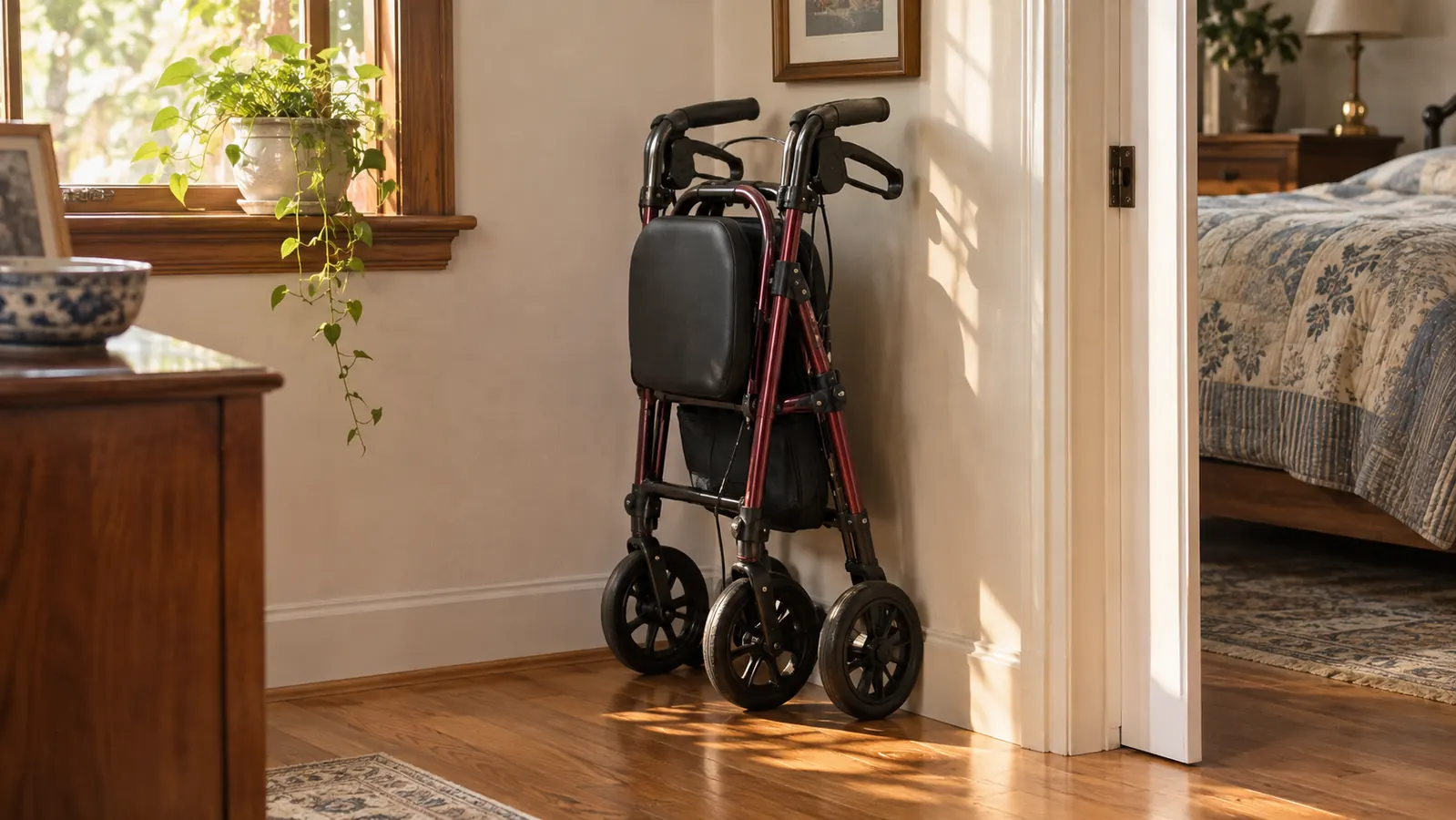
How It Has Held Up Over Two Years
I expected to be replacing this thing by now. I am not.
The frame has no rust and no wobble. The seat padding has compressed a little where Walt sits on the same spot every time, but it has not split and it does not look shabby. The folding mechanism still folds and still locks when it opens. The back support still flips up and down without sticking. The brake cables have not needed adjusting, which honestly surprises me given how much use they get.
The wheels are the wear item. Ours are starting to look a bit scuffed and there is a small flat spot where Walt braked hard on the driveway one afternoon. I have been told the wheels can be replaced. I have not done it yet, and it is on my list for this spring.
The one thing that has degraded is cosmetic. Something got spilled on the seat in the first year, and it left a faint mark. The warranty, which is a limited lifetime one, covers the frame, not a stain. That is fine, I just want you to know that a rollator used daily looks used after two years. Ours does not look new. It does look sound.
I clean it about once a month, which takes a damp cloth and four minutes. I wipe the seat, the grips, and the crossbar, and I pull stray hair out of the front wheel casters, which is the one bit of upkeep nobody mentions to you. Hair and carpet fuzz wrap around those caster axles and eventually make a wheel drag. The first time it happened I was sure a wheel was failing. It was a hair. If yours starts pulling to one side after a year, look at the casters before you order a part. The folding latch is the only other thing I check, and it has never once failed to catch.
What I Liked
- Steel frame takes weight without flexing, and never felt unstable in two years of daily use
- The padded seat and fold-up back support are the reason walks actually happen instead of getting cut short
- Handles adjust from 31 to 37 inches with a lever on each side
- Folds down and fits in the trunk of a mid-size sedan
- Hand brakes with a locking press, tested and workable
- Limited lifetime warranty on the frame
- Held up for two years with no rust, no wobble, no cable adjustment
Where It Falls Short
- Twenty pounds is a genuine lift into a car trunk, and it is a two-hand job
- 23.5 inches wide, which rules out narrow bathroom and hallway doors
- Not usable on gravel, grass, or rough yard ground
- Only 7.5 inch wheels, so cracked concrete needs a slow pace
- Seat is a rest stop, not a comfortable chair for long sitting
- Daily use leaves visible cosmetic wear on the seat
What Nobody Tells You About the First Month
I want to say something to the caregiver rather than the person using it, because I was the one who needed to hear this.
The first month is going to feel like a fight and it is not about the equipment. Walt did not want to be seen with it. He did not want the neighbors to see him with it. He walked beside it for a while before he would hold it, which is a thing I now know is common and which I handled badly by pointing out that he was not holding it.
What worked was changing the frame. We stopped calling it a walker and started calling it the seat, because that is what he wanted from it. We also started using it inside the house first, on the long hallway from the bedroom to the kitchen, where there was no audience. By the time we took it out on the block he had already decided it was his.
The other thing nobody tells you is that you will become the brakes. Walt brakes fine now, but there was a stretch when I walked on his downhill side on every slope and held the far handle with two fingers. Plan on that. It is not a failure of the product. It is just what the first few months of anything new looks like.
You will also move furniture, and you should just move it instead of arguing with it for a month like I did. Our living room gap between the couch and the coffee table was about eleven inches. We pushed the table toward the window and got it to nineteen. It looks a little strange in the room and I do not care. In the kitchen I moved the trash can out of the walkway between the back door and the table. Walt noticed the coffee table and never noticed the trash can, which tells you which changes are worth explaining and which ones you just make quietly on a Tuesday.
Who This Is For
This rollator suits someone who can still walk but tires, and who needs somewhere to stop. That is exactly Walt. It suits someone whose main problem is steadiness rather than foot clearance, someone who wants to keep taking walks around the block, and someone with a house whose main paths and main bathroom door are wide enough. It suits a household with a second person who can lift twenty pounds into a trunk.
It also suits the caregiver who wants to stop being a human handrail. That is the part I did not expect to feel so strongly about. For a year before we bought this, my right arm was Walt's balance. Now it is not, and my shoulder has stopped aching. If you are the one being leaned on, that alone may be worth the money to you.
Who Should Skip It
Skip it if the person you are caring for has significant hand weakness or grip trouble they cannot work around, because the brakes are squeeze-style and the locking press takes a firm hand. Talk to the therapist about what else exists.
Skip it if your hallways and bathroom doors are narrow, because 23.5 inches does not negotiate. Skip it if you want something for grass or gravel, because these wheels are made for pavement and floors. Skip it if nobody in the house can lift twenty pounds, because it will live in the trunk or it will live in the garage and neither is what you paid for. And skip it if the intent is a shower chair or a bedside rail, because it is neither of those, and we bought those separately for a reason.
One more thing, and I mean this plainly. This is equipment that makes daily life easier and safer. It does not treat Parkinson's and it does not slow it down. Walt still sees his neurologist every few months, and every change we make around the house gets mentioned at that appointment first. Please do the same.
If your doors clear 23.5 inches, this is the one I would buy again
Two years in a Parkinson's household: steady frame, seat that gets used every single walk, brakes that hold. Check today's price before you measure.
Amazon Check Today's Price on Amazon →