

The worst ten minutes of my day used to start at 6:40 in the morning. Not the walk around the block. Not the shower. Getting Walt from lying down to sitting on the edge of the bed, and then from sitting to standing.
My husband is 71. Parkinson's moved into our house seven years ago and has taken things in the order it felt like taking them. First the handwriting got small. Then the right hand started tapping when he is tired. Then the shuffle, the freezing in doorways, and the trouble getting up out of anything low and soft. Our mattress is both of those things.

For about a year I did the lifting myself. One arm behind his shoulders, and then I hauled. Some mornings it worked on the first try. Some mornings it took three, and on the third my lower back would file its complaint and I would spend the rest of the day moving like a woman twice my age. That is when I finally went looking, and the thing I bought was the Lunderg Bed Assist Rail.
We tried the free things first. Extra pillows stacked behind him so he had something to push against, which worked until the pillows slid. A kitchen chair pulled up beside the bed, which is a fine way to break a hip before you have had coffee. His physical therapist was the one who brought up adaptive gear in the first place, and a bed rail was at the top of her list.
The rail went on his side of the queen bed about ten months ago. It is a U-shaped frame of carbon steel, tested to 300 lb, and it arrived partly put together. The listing says five minutes and no tools. It took me closer to ten, by myself, and I am not a handy woman. A strap runs under the mattress to hold it where you put it, and that strap is why it stays put when he leans on it.
The first morning, he pushed down on the rail and sat up. Then he did it again that night, and again the next morning. I stood beside him instead of underneath him, and I have not hauled him out of that bed since.
Some mornings it used to take three tries. Now it takes one, and I am standing beside him instead of underneath him.
The morning haul is the part nobody warns you about.
The Lunderg Bed Assist Rail is a U-shaped carbon steel frame with a strap under the mattress, a tool-free setup, and a fit for mattresses from 7 to 13 inches. It works on either side of the bed.
Amazon Check Today's Price on Amazon →The night trips matter more than I expected. Walt is up once or twice, and in the dark he needs something that is where it was yesterday. The rail is on his side, the strap keeps it there, and his hand finds it without me turning on a light and waking us both up properly.
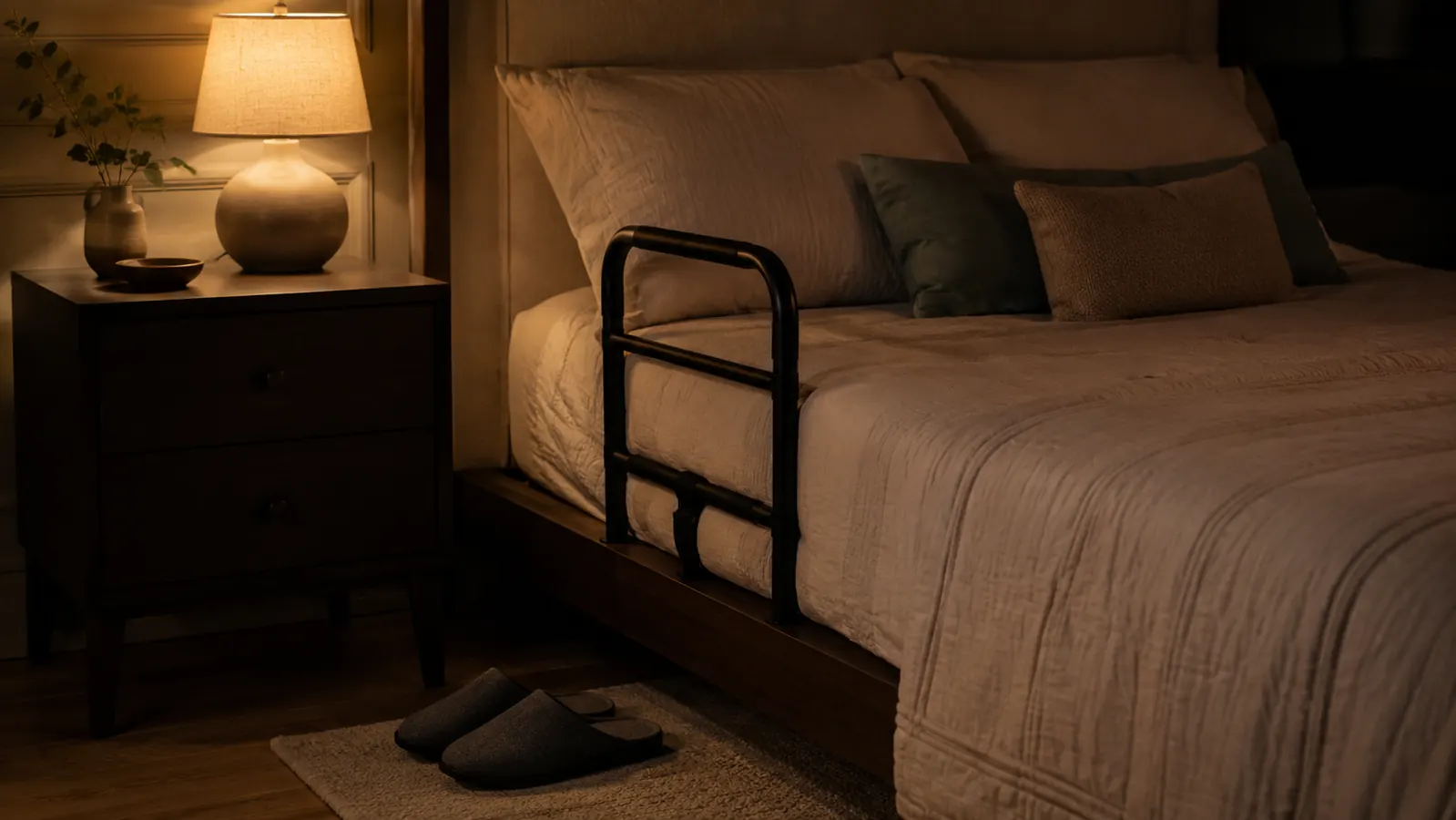
What it does not do is lift him. It is a handle, not a hoist. He still does the pushing, and some mornings the pushing is slow and small and takes a while. It does not stop the tremor either, and it does not make his legs quicker. It gives him one sturdy thing to hold at the moment he needs it. It also does not treat anything. It does not replace the exercises his neurologist and physical therapist gave him, and I would be doing you a disservice if I let you believe a piece of steel does the work a body has to do.
My own back is the quieter part of this story. I am 66, and I spent my working life at the front desk of an elementary school, which is not a job that builds a sturdy lower back. The rail did not fix my back. What it did was stop the daily damage, which is the closest thing to a fix I was going to get.
Some practical notes if you are thinking about one. Measure your mattress, because the fit is 7 to 13 inches and ours sits on the thicker side of that. It works on either side of the bed, so it does not care whose side it is on. The frame is 13 inches wide and 13 inches tall, and it wipes down with a damp cloth, which matters more than you would think in a house where someone has a tremor and a glass of water at the bedside. If your mattress is soft, check the strap every few weeks. I check ours the same way I check the stand assist on the couch.
One honest complaint. It takes up a few inches at the edge of the mattress, and Walt noticed it the first week when he rolled toward the middle. He got used to it faster than I expected. I would rather he notice the rail than have me notice my back.
What I'd Tell You If We Were Sitting at My Kitchen Table
I would tell you that getting out of bed is not a small problem, and it is not only about bed. It is about whether Walt can get himself to the bathroom at two in the morning without calling for me, and whether I can still lift the rollator into the trunk of the Buick and take him to the diner on Sunday. Every piece of gear in this house has been about keeping the ordinary things ordinary. I would tell you to ask his neurologist or his physical therapist before you change anything about how he moves, because I am not a doctor and I will not play one at my own table. And I would tell you that if your mornings look like my mornings used to, the Lunderg rail is the least dramatic thing we have bought and the one I would buy again first.
If your mornings look like mine used to
The Lunderg Bed Assist Rail sets up without tools, holds with a strap under the mattress, and puts a handle where his hand already goes. Ask his care team first, then take a look.
Amazon Check Today's Price on Amazon →