

The first thing Parkinson's takes, in our house anyway, is the easy business of getting out of bed. My husband Walt is 71 and was diagnosed seven years ago. For a long stretch, mornings went like this. He would push up to sitting, get about halfway, lose the push, and lie back down. Then we would try again. Some days it took three tries, and by the third one my lower back was talking to me and he was embarrassed, which is worse than the back. Ten months ago we put a Lunderg bed assist rail on his side of the queen bed. It did not fix one thing about Parkinson's. It made one hard part of the day easier, and it gave me back a job I could do without hurting myself.
What follows are ten reasons it stayed. Not a sales pitch. I am not a nurse and I am not a physical therapist, and nothing here treats anything. It is a piece of carbon steel that gives a man somewhere to put his hand. Before you change anything about how your person gets in and out of bed, call the neurologist or the PT and tell them what you are planning. Ours was the one who suggested adaptive gear in the first place, and she was right.
Mornings Used to Cost Two Tries. Now They Cost One Push.
One rail, no tools, about ten minutes to fit. The Lunderg bed assist rail is the single piece of gear that changed our morning routine the most.
Amazon Check Today's Price on Amazon →Cuts a two-try morning down to one steady push
This is the reason we bought it and the reason I would buy it again. Walt's problem was never sitting up in the morning so much as the push running out halfway. He would get to his elbows, stall, and go back down. The rail gives that push somewhere to land. He rolls to the edge, gets his hand around the bar, and stands from there. Most mornings now it is one try. Not every morning. On a bad tremor day it is still two, and I still stand close. But the average morning is shorter and quieter than it was a year ago, and that is the whole ballgame.
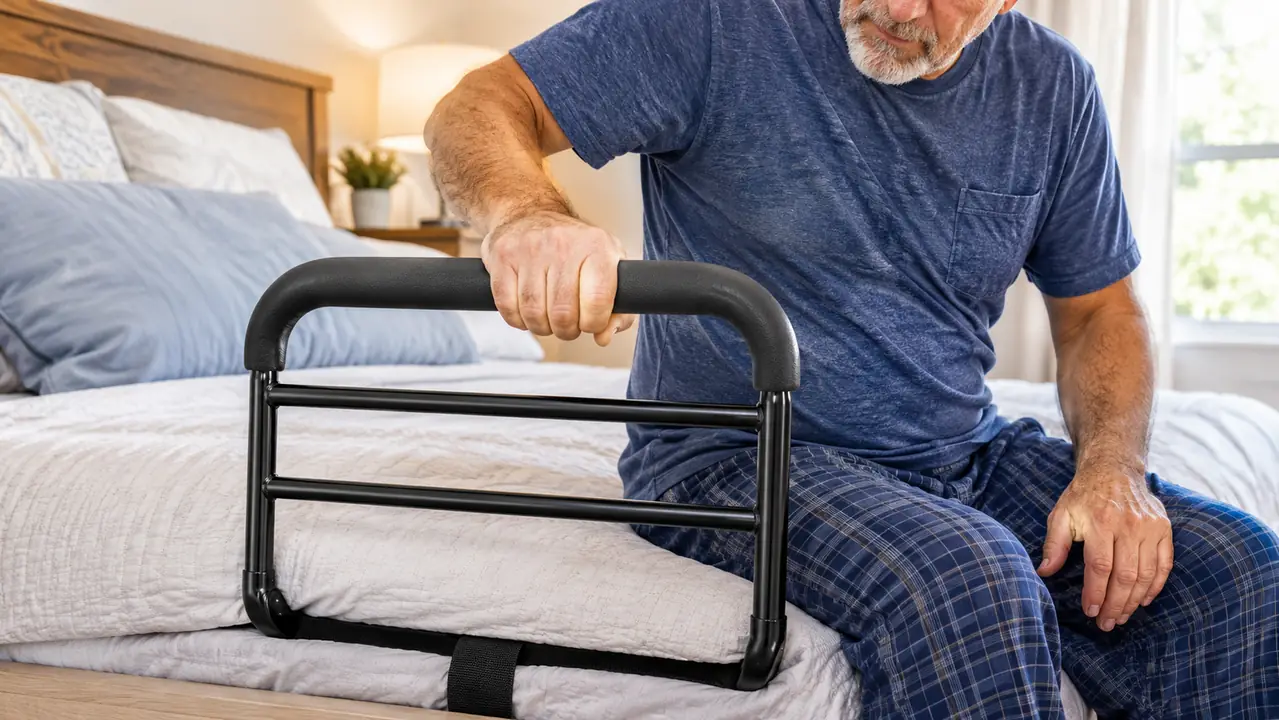
Goes together in about ten minutes with no tools at all
The listing says five minutes and partly pre-assembled. I took ten, because I read the directions twice and I am the kind of person who does. No screwdriver, no drill, nothing mounted to the wall or bolted to the frame. It slides in under the mattress and the strap goes around and under. I did it alone on a Tuesday afternoon while Walt watched the ballgame and offered commentary. If you have ever assembled a piece of adaptive gear with an Allen wrench and a diagram drawn by an optimist, you will understand how rare that is.
The strap keeps it exactly where you put it
One thing I did not expect to care about. A rail that shifts when a grown man leans on it is worse than no rail, because it teaches him not to trust it. The adjustable strap on the Lunderg runs under the mattress and holds the rail tight to the bed, so it does not walk away from him overnight. I give it a look about once a month when I change the sheets. Ten months in, it has not needed tightening. If you have ever had a grab bar slide on you in a bathroom, you know why this matters more than the marketing copy suggests.
Gives him something to pull on that is not your shoulder
This one is about dignity as much as safety. For a while there, Walt's hand on my shoulder was the plan, and I could feel him trying not to lean too hard, and he could feel me bracing. Nobody likes that arrangement. The rail is a fixed thing. It does not flinch, it does not get tired, and it does not make him feel like a burden at seven in the morning. He uses it, I stand by the door. That small change in who does what has been worth more to us than the rail itself, honestly.
Saves the caregiver's back, which nobody budgets for
Ten months before we installed it, I hurt my back helping him up from the edge of the bed. Not a dramatic injury. Just a pull that took weeks and made me useless for lifting anything heavier than a laundry basket. Caregivers get hurt doing exactly this, over and over, at six in the morning, and nobody counts it. The Lunderg rail moved that load off my shoulders and arms and onto carbon steel tested to 300 lb. My back has not complained since. If you are only looking at this from his side of the bed, you are missing half the reason to buy it.

Holds steady for the two in the morning bathroom trips
Walt gets up once, sometimes twice, in the night. That is the version of this that used to scare me, because he is half asleep and the tremor is worse when he is tired. The rail is right there in the dark, at the same height every single time, and he does not have to feel around for it. The non-slip grab bar feels the same at two in the morning as it does at seven. I sleep better than I did a year ago. That is a plain fact and I will take it.
Fits our queen, and it works on either side of the bed
Ours is a queen and the rail fits with room to spare. The listing covers twin through king and mattresses from 7 to 13 inches thick. It can go on either side, which matters if your room layout changes or if your person sleeps on the other side from mine. We put it on Walt's side, the side nearest the bathroom door, because that is the side he gets out on in the dark. One caution: if you have a very thick mattress topper, measure before you order. Ours is a standard mattress and there was no issue at all.
The bar is sized for a whole hand, not two fingers
This is a tremor detail and I wish more gear got it right. A narrow bar is exactly what a shaky hand cannot hold, because it needs a pinch grip. The grab bar on this rail is a hand-sized piece of steel, listed at 13 inches wide and 13 inches high, so there is room to get a full grip and room to change grip as he stands. On bad days he pushes down with the heel of his hand instead, which he does more often than he will admit to me.
Wipes clean and asks nothing else of you
Carbon steel, a damp cloth, that is the entire maintenance routine. No batteries, no moving parts, nothing to charge, nothing that beeps at three in the morning. I wipe it down when I wipe down the nightstand and that is the end of it. When you are already managing a house, a medication list, a calendar of appointments and a husband who used to do all the fix-it jobs himself, equipment that asks nothing of you is not a small thing. It just sits there being solid.
One rail on his side, not a hospital bed in the bedroom
We looked at the bigger setups and I did not want our bedroom to look like a ward. This is one rail on one side of a normal bed. The other side is still our bed. The sheets still fit. It does not read as a piece of medical equipment sitting in the corner, and Walt does not feel like a patient in his own room, which for him has been the difference between using something and refusing it. If your person is stubborn about gear, and mine is, that matters more than any specification on the box.
What I'd Skip
Two things. First, I would skip waiting for a fall to justify it. We waited, and the fall we waited for happened on the driveway, not the bedroom, and it scared us both into action we could have taken months earlier. Second, I would skip anything that needs drilling into the frame or mounting to the wall, because you cannot undo a hole in a bed frame and you cannot easily move the setup if his needs change. That tool-free part of the Lunderg is the reason it is still on our bed and not in the garage. I would also skip a second rail on my side. One side is enough for us and the other side needs to stay mine. Start with one, live with it a month, and see what you actually need. Then call the PT and tell her what you did, because she will have opinions and they are usually better than mine.
Ten months in, the average morning is one push instead of two, and my back has stopped being part of the plan.
If Mornings Are Still a Two-Try Job, Start With This
The Lunderg rail needs no tools, no drilling, and about ten minutes to fit, with a strap that holds it under the mattress. It is the first thing I would buy again if we were starting over.
Amazon Check Today's Price on Amazon →